
| Constructing a Mercury Vapour moth-trap |
| For years, entomologists
have used mercury vapour bulbs to attract moths, as MV
bulbs emit a high proportion of their light as ultra
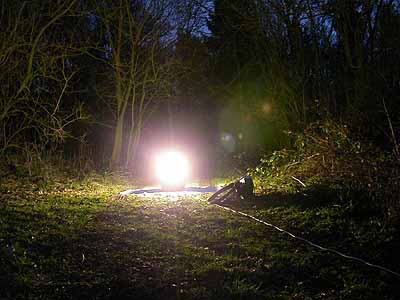
violet making them especially attractive to moths. An MV light is simply, the best way to attract numbers of moths within a relatively short period of time and is suitable for conducting random sample surveys, to determine what species are present in a given site/area or to aid the assessment of resident populations with regular trapping. A single night's trapping in woodland during the Summer months, can result in well over a thousand moths being caught on favourable night, but moth traps run from urban and suburban gardens can also turn up some excellent and often surprising results and species. Take for instance the Marsh Oblique-barred (a species new for VC56) from a garden in the middle of Market Warsop in 2021. |
 |
|
| ..... | ||
| Trap
construction Although traps are available to buy from entomological suppliers, building a trap yourself is far cheaper. Constructing a trap is a simple enough procedure, even if your woodworking skills are pretty basic and the electrics are readily available from most electrical wholesalers and large DIY stores, though selected parts (the choke and bulb) may have to be ordered. If you don't feel comfortable with wiring electrics, get an electrician. |
||
| ..... | ||
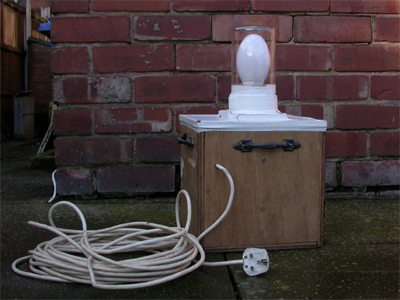
| The trap we use is just a
simple box with the bulb mounted on top and the choke and
other electrics housed inside and waterproofed inside a
plastic box. 12mm thick plywood was used for strength and
durability. The top of the box is also waterproofed with
insulation tape and the outside of the box is finished
off with varnish. There are other trap designs which allow the moths to be retained overnight within the trap and emptied out the following morning, but we find this type of trap to be ideal for the usually short trapping sessions we employ and allows the moths to arrive and leave the trap at will. You will of course need a net. To construct a trap similar to the design we use, the following items are required. One 125W Mercury Vapour light bulb, a Choke (we use a Parmar Q 125-24.2-4) one porcelain lamp holder, a suitable length of three-core electrical cable and one or two sheets of exterior plywood measuring 606mm x 1220mm x 12mm. |
 |
|
| ..... | ||
 |
It is always best to
carry at least one spare bulb, as these will inevitably
pack up one night, when you switch the trap on after a 20
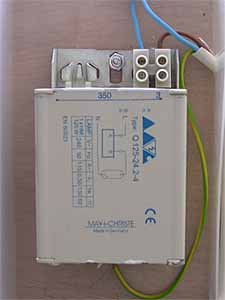
mile trip on a particularly favourable night. Electrics and wiring The choke regulates the amount of power going to the bulb as it fires up, allowing the bulb to warm-up gradually. It should be wired as shown in the photograph on the left. The wiring is fairly simple. Standard three-core cable should be stripped back and the wires cut to appropriate lengths for connection as instructed below. The choke and all the electrics, were encased on the side of the original trap design, to avoid any contact with the ground and dampness. Live (Brown) is connected directly to the choke. Neutral (Blue) should be connected to one side of the porcelain bulb holder. An additional length of the same wire is needed to run back to the choke from the bulb holder. Earth (Yellow/green) is connected directly to the choke via one of the fixing screws, on the side of the box. |
|
| ..... | ||
| Care should
be taken to protect all electrics from water. In many
cases where people trap moths in their own gardens, traps
are left on all night and checked in the morning. When
trapping moths at sites away from home, sessions are
often much shorter, but dew can start to form at dusk and
cause a problem. Mercury vapour bulbs run at very hot temperatures and rain can be a hazard and an unprotected bulb can explode if it is particularly cold or there is heavy rain. As such, it is wise to cover the bulb with a heat-resistant glass cover, such as the glass from a cafetiere. Portable power supplies In order to provide electricity away from home, a portable generator is needed. Top quality generators can be up to £500-£800 and are an unrealistic proposition to many. There are cheaper generators on the market and although these are berated by many in favour of the more expensive models, are much better value for money in our opinion. In 2003, the first generator we purchased was a Powercraft 720 portable generator from Aldi. It cost much less than £50, but performed excellently for a number of years until 2008, when it eventually failed. A slightly more powerful Omega Wolf generator was then purchased for £69 and the company went into administration in 2010, but we still use the same generator today (2015). |
||
| ..... | ||
| This original trap design
was later modified into a simple, smaller square box with
the light sat on top and the choke and all electrics
housed within the box. This made the whole trap and
generator easier to get into the boot of the car and if
trapping in the field and attending the trap for a few
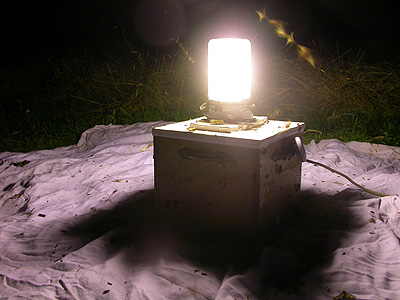
hours at a time, then this design certainly works best. We have never run a trap all night yet and when trapping away from home, find it is not really practical. Our trapping sessions can last from an hour to four or five hours, depending on the weather or work commitments etc. Moths will alight on the box itself, the sheet or surrounding vegetation and can be potted for later identification as and when required. Many moths will stay at the light for a while, but often become active and fly off later, so the potting up of any specimens is best done immediately after they arrive at the trap. Right: The light trap in operation at Sherwood Forest NNR during June 2009. |
 |
|
| ..... | ||
| An added
advantage of a simple box trap is that Hornets and other
predators cannot get into the trap and eat most of your
catch. Two or three Hornets are attracted most sessions
during the late Summer and Autumn and they can be safely
potted up and released after the trapping session, or
just left to settle down on their own. When to start and where We would always recommend that anyone new to the hobby starts moth trapping in February or March. Running an MV moth trap for the first time in deciduous woodland during July, will usually result in the beginner being totally overwhelmed by the shear number of moths and species which turn up. It is far better to pick a mild night in February or March, where the temperature is near, or into double figures, or to run the trap from home. MV lights are extremely bright and can annoy neighbours if placed where the light shines directly into bedroom windows. This can often be overcome by blocking the light from shining directly on to neighbouring properties, by strategically placing obstacles or hanging dark coloured sheets over washing lines. The number of moths will be lower at most garden traps, but much more manageable, but the downside to trapping from home, is that you develop the urge to trap every night for fear of missing something. There is no harm in running a moth trap every night of the year, but we find that just a couple of hours is more than adequate, as it has less impact on moth behaviour and breeding. For our beginners guide to moths and moth trapping, click on the link below. |
||
