
| Migrant moths in Nottinghamshire and our own records 2020-2026 |
| Because of the increasing file size and download time, it has been necessary to split the results into three pages. Migrant moth records from 2004 - 2009 and 2010 - 2019, can be accessed via the links at the bottom of this page. Please note that both these other pages, also have the same introductory text and photographs. |
| Come any Autumn, regular
moth-trappers tend to have an eye on the latest weather
conditions. This meteorological interest, stems from the
dream of having a rare migrant moth enter the light trap,
or at least still be there when the trap is opened the
following morning. We run a mounted MV light on a white ground sheet and stay at the light, so immediately notice as soon as any moth drops in. And if its one of the less regular migrant moths, then it can make the difference between packing up after a couple of hours, or continue trapping for much longer. We occasionally used to trap with the possibility of migrants in mind and had success when trapping at open, elevated sites in the Eakring area a number of years ago. In 2006, we watched moths coming to the light, across open fields from the south-west on several occasions. |
 |
|
| . | ||
| On rare
occasions (the last again being back in 2006) several
such migrants suddenly began to appear after midnight. On
those particular nights, it soon became evident that
something special was taking place and if we had been
able to continue trapping longer than we did, who knows
what we might have trapped. As a rule though, don't just
run a moth trap in Nottinghamshire for migrants, as it
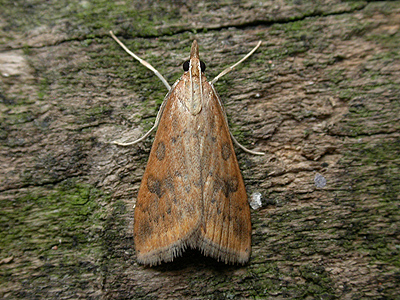
will often disappoint. Migrant moths - what species to expect Apart from Silver Y and Plutella xylostella (Diamond-back Moth), migrant moths inland are relatively uncommon against the background of resident species. Both are annually occurring migrants which reach Nottinghamshire and other inland counties each year. While having these turn up at the light can occasionally be indicative of large-scale migration, more often than not, they are purely the resulting offspring of moths arriving earlier in the year. Our three commonest migratory micro moths are Plutella xylostella (Diamond-back Moth) Nemophila noctuella (Rush Veneer) and Udea ferrugalis (Rusty Dot Pearl) and usually in that order of frequency. Not all turn up in Nottinghamshire each year and of the three, we have only recorded Udea ferrugalis occasionally, but all three will eventually turn up in most peoples light traps at some time. |
| . | ||
| What many moth trappers
are really after though, are the rarer migrants such as Vestal, Gem,
Dark Sword-grass, Pearly Underwing, Bordered Straw and Scarce Bordered
Straw. But there are potentially a
whole host of others and the change in status of some once much rarer
species, has probably changed many a recorder's wants list within the
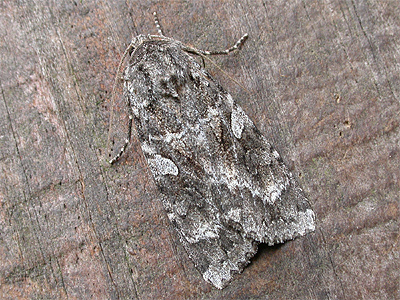
past few years. Perhaps the ultimate species on anyone's personal wants list, would be Clifden Nonpareil, Convolvulus Hawk-moth and perhaps Death's-head Hawkmoth. All three have occurred in Nottinghamshire, with Clifden Nonpareil now being a regular occurrence and increasing. While lepidopteran heavyweights with a big wingspan represent the larger end of the scale, there are many smaller moths that make it to the UK's south coast and occasionally even futher inland. Most are from the families Crambidae and Pyralidae and include a range of attractive species such as Palpita vitrealis, Antigastra catalaunalis, Ostrinia nubilalis (European Corn-borer) and Spoladea recurvalis are typically hoped for species, with all four having been recorded in Nottinghamshire. Right:- Great Brocade trapped by David Yates at Southwell in August 2010 |
 |
|
| . | ||
 |
Commonest of our regular migrant moths
though are Hummingbird Hawk-moth and Silver Y. Hummingbird Hawk-moth
records have increased in recent years and they are traditionally day-flyers, but are known to
occasionally turn up at MV lights sited on the coast,
although we are not sure if this has ever been known to
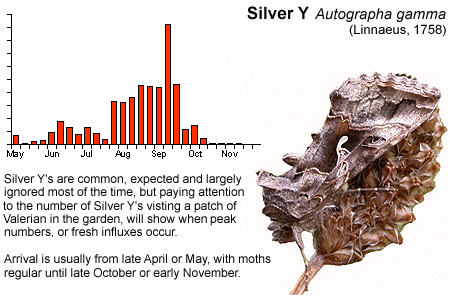
happen in a land-locked county such as Nottinghamshire. Silver Y's are very common, expected and largely ignored for most of the time, but paying attention to the number of Silver Y's visting a patch of Valerian in the garden, can show when numbers are peaking and an indicator of when other (potentially much rarer) species are perhaps more likely. Peaks in numbers are due to either an emergence of fresh moths resulting from arrivals earlier in the Spring, or part of an influx of new migrants reaching the UK. Good 'migrant years' don't happen very often and are sometimes heralded by the early arrival of common migrants such as the Silver Y. 2013 was relatvely good, but the last big influx of migrants was as long ago now as 2006, when even inland counties had their fair share of the action. |
|
| ... | ||
| The influx involved many of the species typically reaching the UK most years, during what was an amazing period of migration. We recorded our rarest migrant in 2006, when we trapped a single Euchromius ocellea at one of our Eakring sites on an excellent night for migrants, but also recorded Bedstraw Hawk-moth, many Hummingbird Hawk-moths and most of the rarer migrants the same year. Pearly Underwing, Small Mottled Willow and Scarce Bordered Straw, all remain generally uncommon or rare at Nottinghamshire light traps, but will often reach inland counties during notable influxes of migrants. | ||
| ..... |
| Brief
summary of the migrant, accidental or adventive moths
recorded in Nottinghamshire These summaries are based on the latest information and records available at the time of writing. There are occasional updates made to these species summaries, but some of the information and especially the status of some species, may have changed since the previous update. Please note that I have now stopped all updates to the species summaries below. |
||
| ..... | ||
| Plutellidae | ||
| Plutella
xylostella Diamond-back Moth |
An annual migrant to most parts of the UK and Nottinghamshire, being common most years. Occasionally disturbed in large numbers during the day, when walking in agricultural areas. | |
| ..... | ||
| Gelechiidae | ||
| Scrobipalpa ocellatella | A migrant/adventive species regarded in some countries as a potential pest species of Sugar Beet crops. There were records from Broadholme on the Nottinghamshire/Lincolnshire border, Market Warsop and Eakring in 2022 (probably other sites too) and it was thought to be breeding in Nottinghamshire, but there have been few records (Lound Wood and Market Warsop) in 2023. | |
| ..... | ||
| Tortricidae | ||
| Cydia amplana | Currently six Nottinghamshire records, but the situation changes quickly as more records come in, with singles at Broadholme on September 5th 2021 and again on August 4th 2026 (Gray, M.), Radcliffe-on-Trent in 2024 (Dulwich, P.), from Misterton on August 3rd 2026 (Lee, P.) and from Nottingham on August 11th 2026 (Hill, M.) and Langford Lowfields (2) on August 14th 2026 (Cornish, C. and Dawson, M.). | |
| ..... | ||
| Pyralidae | ||
| Acrobasis tumidana | A rare migrant to southern counties of the UK. Nottinghamshire's first record, was recorded in a West Bridgford garden on July 17th 2025 (Freestone, R.). | |
| ..... | ||
| Loxostege sticticalis | Primarily regarded by most
authorities as a migrant, despite the possibility of this moth being
resident in the Breckland district of East Anglia. The number of reports
from southern counties has increased in recent years, but
at one time, Nottinghamshire's only records were of singles
attracted to MV light at Broadholme on August 22nd 2003
(Gray, M.), before one at Elkesley on July 30th 2019
(Coombes, P.). In early September 2022, there was an unprecedented influx both nationally and into VC56, with records from Broadholme September 1st 2022 (Gray, M.), two at Tollerton (Watson, T.) and a single at Lound Wood, Eakring (Pendleton, T.A.) on September 2nd 2022, a single at Underwood (Hector Brown, K.) on September 3rd and then a single at Misterton (Lee, P.) and two at Red Hill, Eakring on September 4th (Pendleton, T.A.). |
|
| ..... | ||
| Antigastra catalaunalis | There is currently just a single record, from Broadholme on the Nottinghamshire/Lincolnshire border (but in VC56) on September 26th 2006 (Gray, M.). | |
| ..... | ||
| Ostrinia nubialis
European Corn-borer |
There are increasing
records of this moth in
Nottinghamshire, which is becoming more regular. Nottinghamshire's first record came from Roger Freestone's West Bridgford garden on September 9th 2022 and there have since been a number of follow-up records from South Muskham on July 29th 2024 (Kennewell, M.), Broadholme on June 21st 2025 and again on August 24th 2025 (Gray, M.), with others to light at Keyworth on August 17th 2025 (Pinder, N.) and four at Collingham on August 24th 2025 (Kennewell, M.). |
|
| ..... | ||
| Udea
ferrugalis Rusty Dot Pearl |
A common migrant to the UK and often reaching Nottinghamshire. It does not appear to be recorded annually and often only turns up during years of particularly notable influxes, as took place in 2006 and 2011. | |
| ..... | ||
| Duponchelia fovealis | An
adventive/accidental species with few UK records.
Although recorded in the UK as a migrant, most records
are the result of accidental importation on cut flowers
or house plants from southern Europe. There are four Nottinghamshire records, with the first being found freshly emerged on the skirting board of a Mansfield nursing home and believed to have originated from a larva brought in with a bunch of cut flowers on October 14th 2011 (Pendleton, T.A. and Pendleton, D.T.). There have since been records of singles to MV light at Misterton in 2013 (Lee, P.) and Market Warsop on September 1st 2018 (Pendleton, T.A. and Pendleton, D.T.) and Market Warsop again on October 7th 2023 (Pendleton, T.A.). |
|
| ..... | ||
| Spoladea recurvalis | Extremely rare in Nottinghamshire, but the number of records nationally is increasing. There is a single record from a Sutton-in-Ashfield garden on September 22nd 2010 (Wilson, J.). | |
| ..... | ||
| Palpita vitrealis | The number of Nottinghamshire records of this stunning Pyralid,
continues to increase. One taken at light from Hagg
Wood, Newstead Park on October 30th
1992 (Cooper,
K.), remained Nottinghamshire's only record until 2020, until
one was recorded from Stanton-on-the-Wolds on July 21st 2020
(Mathers, S.), with others
recorded from a
Colwick garden on October 25th 2022 (Shields,
T.) and East Bridgford on October 9th 2023 (Reece, J. and Reece, L.). 2024 saw singles at Elkesley on August 5th 2024 (Coombes, P.), Newark August 26th (Atkinson, D.), East Bridgford again on August 27th (Reece, J. and Reece, L.), Keyworth August 28th (Pinder, N.), Langford Lowfields September 7th (Morton, D. and Ashley, A.) another from East Bridgford on October 5th (Reece, J. and Reece, L.) and Misterton (Lee, P.) on October 25th 2024. Another at Misterton on August 24th 2025, was the first of the year and others followed over the next few days, at Radcliffe-on-Trent August 25th, Besthorpe NR August 26th, East Bridgford on August 26th, Nuthall on August 29th and Newark on September 1st. |
|
| ..... | ||
| Nomophila
noctuella Rush Veneer |
Occurs on an almost annual basis and is occasionally very common in some years such as 2006 and 2015. Can often be disturbed from vegetation during the day. | |
| ..... | ||
| Ancylosis oblitella | A former scarce migrant moth to the UK, colonising
south-eastern counties back in the 1950's, Ancylosis oblitella
is a rare moth in Nottinghamshire and still presumably regarded as a
migrant to the county. One recorded at MV light from the Red Hill area of Eakring on August 8th 2004 (Pendleton, T.A. and Pendleton, D.T.), remained the county's only record until another was recorded from Langford Lowfields on August 11th 2025 (Morton, D. and Ashley, A.), then a third to light at Broadholme on August 24th 2025 (Gray, M.). And there's been recent records from Besthorpe NR on September 13th 2026 and Misson Carr on September 22nd 2026 (both Pendleton, T.A.) and presumably others. |
|
| ..... | ||
| Euchromius ocellea | Nottinghamshire's first (and for many years) only record, came from Eakring on September 12th 2006 (Pendleton, T.A. and Pendleton, D.T.), occurring on an evening of notable migrant activity and arrivals. A second county record followed some years later, with one taken at light from Ravenshead on September 20th 2024 (McGeever, D.), which was part of a large influx of this moth into eastern counties of the UK at the time. | |
| ..... | ||
| Cydalima
perspectalis Box Tree Moth |
An adventive
species of Asian origin, first recorded in the UK as
recently as 2008. Probably introduced into the UK via the
horticultural trade, it is firmly established in the
London area and now spreading north and it has been breeding in
Nottinghamshire since 2019 (Mapperley). The first Nottinghamshire records came from Bestwood Village on July 5th 2018 (Tobin, S.) and Ravenshead on July 17th 2018 (McGeever, D. and McGeever, V.). Regarded as a pest species of Box (Buxus sp) it has become increasingly more common in the county and can occur well away from it's host plant. |
|
| ..... | ............................................................................................................ | ..... |
| Sphingidae | ||
| Agrius
convolvuli Convolvulus Hawk-moth |
A rare
migrant to Nottinghamshire, with scattered records across
the south of the county. There were
a total of five Nottinghamshire records in 2003, which
was notable for the best ever influx of this moth into
the UK. In 2020 there were records are from Ravenshead on August 20th 2020 and September 13th 2019 (McGeever, D. and McGeever, V.) West Bridgford on September 12th 2015 (Hurst, A.) and Misterton in August 21st 2022 (Lee, P), but there were a number of other records from 2022 including Radcliffe-on-Trent, Wollaton, East Bridgford, Sutton-in-Ashfield, Caythorpe and Bulcote (two larvae). There were two records from 2023, of two larva found at the side of the River Trent at Collingham on July 30th, followed by an adult by day, at Retford on October 12th (Watkin, C.). 2024 records include singles at Broadholme on August 28th and September 6th (Gray, M.), at Newthorpe on September 2nd and 7th 2024 (per Viles, I.), Underwood September 6th (Hector Brown, K.) Ravenshead on September 20th (McGeever, D. and McGeever, V.) and East Bridgford on October 16th 2024 (Reece, J. and Reece, L.). The latest records involve singles found at Darlton (per Leonard, P.) on September 5th 2025 and another to MV light at East Bridgford on October 5th 2025. |
|
| ..... | ||
| Acherontia
atropos Death's-head Hawk-moth |
An extremely rare migrant to
Nottinghamshire, but the Death's-head Hawk-moth was certainly
more regular a century or more ago. J.W. Carr in his book
'The Invertebrate Fauna of Nottinghamshire. Nottingham:
J.& H. Bell Ltd. (1916)' lists numerous records, many
of either larvae or pupae found during potato harvesting.
As harvesting is now done by mechanical methods, reports of this moth's
spectacular caterpillar have largely ceased, although I suspect it still
occurs here, more than we are aware of and there must have been recent
records of larvae in Nottinghamshire. The last Nottinghamshire record of a genuine migrant Death's-head Hawk-moth, was of a larva found in a garden at Rushcliffe on 23/08/25 (Blackburn, F.) but there is a vague claim of one from the Newark area on 30/09/25 but was reported anonymously, for some reason. Previous records are of a female recorded at East Retford on 04/07/66 (Shaw, G. per Nottingham Natural History Museum) and at Lound GP on 10/09/95 (Hobson, G. and Hobson, P.), although the record was not submitted to the county recorder. |
|
| ..... | ||
| Macroglossum
stellatarum Hummingbird Hawk-moth |
A regular
migrant to Nottinghamshire and usually well recorded
being a day-flying species. Numbers vary from year to
year, but recent good years include 2006, 2011, 2015 and 2022. The recent increase in county records has also produced occasional records from the early months of the year, so successful overwintering seems to be taking place, although the vast majority of county records still refer to genuine migrants. |
|
| ..... | ||
| Daphnis
nerii Oleander Hawk-moth |
A very rare migrant to the UK and even rarer inland. There is a single Nottinghamshire record, from Clumber Park in 1985 (Jones, M.). | |
| ..... | ||
| Hyles
galii Bedstraw Hawk-moth |
Rare in
Nottinghamshire and usually appearing slightly earlier in
the year than most other migrant Hawk-moths. There was a recent run of
single records of both adult moths and larvae each year between 2003 and
2011, with blank years in 2005 and
2010. Unreported records include an adult nectaring at Buddleia, King's Mill Reservoir September 6th 2013 and a larva at Sherwood Pines on July 15th 2017. Most recently recorded from Bestwood Village on July 31st 2019 (Tobin, S.) and Stanton-on-the-Wolds on August 1st 2019 (Mathers, S.). |
|
| ..... | ||
| Hyles livicorna Striped Hawk-moth |
Despite being a regular migrant to the UK and reaching inland counties
on numerous occasions, this stunning moth had never been recorded in Nottinghamshire
until 2021, when a single was recorded in a West Bridgford garden
(Freestone, R.). A second record duly
followed on May 13th 2023, from Rampton
(Watkin, C.), but Nottinghamshire missed out on the very large
arrival of Striped Hawk-moths into the UK of Spring 2022, which resulted
in a number of records from neighbouring counties. Nottinghamshire's third ever record, recently turned up at Elkesley in May 2025 (Coombes, P.) during another influx of Striped Hawk-moth into the UK at the time and following another big influx in late May 2026, one was recorded from Newark on May 30th (Gilbert, E.) but there appear to be no other records until singles at Nuthall in August (Hill, M.) and at Langford Lowfields on August 14th 2026 (Morton, D. and Ashley, A.). |
|
| ..... | ||
| Hippotion
celerio Silver-striped Hawk-moth |
J.W. Carr lists several historical records for Nottinghamshire, dating to between 1859 and 1893. The most recent county record is of one found by day at Beeston on June 17th 1984 (Fox, D.). | |
| ..... | ||
| Geometridae | ||
| Rhodometra
sacraria Vestal |
Still a generally uncommon
migrant to Nottinghamshire, largely occurring here after
occasional large influxes into southern parts of the UK.
There were eight records from the county during the
exceptional migrant year of 2006 and then a further five
in 2013. Four individuals were recorded at Broadholme in
2006 (Gray, M.) and the same site produced a
number of other records in 2011, 2013 and 2014 (Gray, M.). Vestals also turned up at West Bridgford in August 2012, from Rampton, Sutton-in-Ashfield and Carlton in 2016, and twice at the Idle Valley NR in October 2017. Recent years have seen additional Vestal records, but this moth has not shown any trend towards greater frequency and it is still only occasional here. There are recent records from Sutton-in-Ashfield in 2018, Retford and Sherwood Forest Golf Course in 2019, West Bridgeford in 2021, then South Musham, Keyworth, Misterton, Ravenshead and Wollaton in 2022. There were four records from 2023, with moths at Attenborough, Stanton-on-the-Wolds, Mansfield and Broadholme. Known records from 2025, include singles to MV light at Besthorpe NR on July 30th, East Bridgford August 3rd, Misterton August 9th and Lound Wood, Eakring on September 19th. |
|
| ..... | ||
| Nycterosea
obstipata Gem |
A rare
migrant to Nottinghamshire. The most recent records we
can trace are from Bunny in 1996 (Marchant, M.), Broadholme on the
Nottinghamshire/Lincolnshire border on August 8th 2006 (Gray, M.) and from Brackenhurst near Southwell on
September 28th 2006 (Wright,
S. Osborne, J. and Beasley, N.). A single record from Misterton Soss on
November 5th 2011 (Wood,
N.), preceded records
from Market Warsop in August
(Chick, S.) and Broadholme again on August 19th 2019. The most recent records are from Market Warsop on October 9th 2021 (Pendleton, T.A.), Colwick on May 27th 2024 (Shields, T.) and Langford Lowfields on August 15th 2024 (Kennewell, M. et al) and from near Southwell on May 13th 2026 (Wakefield, R.). |
|
| ..... | ||
| Macaria
brunneata Rannoch Looper |
There is a resident population restricted to parts of central Scotland. In the UK, it occurs purely as a migrant to southern and eastern counties, but has reached inland several times. There was just a single known Nottinghamshire record dating to sometime in the early 1960's, before a very unexpected influx into eastern counties of the UK in early June 2023, producing at least four county records from Broadholme (Gray, M.), Elkesley (Coombes, P.) Centre Parcs (Hill, M.) and Budby Pumping Station (Morton, D. and Ashley, A.). | |
| ..... | ||
| Erebidae | ||
| Lymantria dispar
Gypsy Moth |
A former UK resident, which became extinct
sometime in the latter part of the 1800's, but after many years
became established in the London
area during the 1990's, even surviving an eradication attempt. It now
seems to be on the point of recolonising other parts of the UK once
more. Always expected to turn up in Nottinghamshire at some time (in view of recent UK records) this moth was recorded new to Nottinghamshire on August 14th 2024, when a male was attracted to a pheremone trap for Silver Y at a West Bridgford garden (Freestone, R.). |
|
| ..... | ||
|
Euplagia quadripunctaria
Jersey Tiger |
Once restricted to the Channel Islands and a
number of sites along the UK's south coast,
in recent years the Jersey Tiger's
range has increased substantially and it is continuing to move north at
a rate. Nottinghamshire's first record came from a Worksop garden on August 5th 2020 (Cadman, P.) occurring during a spell of warm, southerly winds. At the time, this surprising record was not expected to be part of the northerly range expansion the moth has since undergone, and its Nottinghamshire status has subsequently changed considerably over the last few years. In 2021 there were two more Nottinghamshire records, from Kirkby-in-Ashfield (O'Connor, L.) and Rainworth (Robinson, D.) on August 5th 2021 (exactly a year to the day of the county's first record). There followed a blank year in 2022, but in 2023, there were records from eight sites between July 19th and August 9th, including multiple counts/records from sites at Skegby and Mansfield. 2024 followed in a similar fashion, with a total of six records from six sites between July 28th and August 12th. This again included multiple records from the same Mansfield site as in 2023. 2025 saw a huge irruption of this moth across some southern UK counties, although the only Nottinghamshire record I'm aware of, is from Worksop in July 2025, with two more coming in 2026 (Cadman, P.). |
|
| ..... | ||
|
Lithosia quadra Four-spotted Footman |
This species has been on the Nottinghamshire list for many years,
although any historical county records aren't traceable through the
usual sources and there appears to be no modern (post-1990) records.
Formerly regarded as a migrant species, it is now established in some
south-western counties, with records away from those areas uncommon. In 2025, there was a good arrival/movement of Four-spotted Footman in many southern counties of the UK and two Nottinghamshire records associated with the influx, came from Ploughman's Wood on 14/06/25 (Shields, T.) with another at Langford Lowfields on 17/06/25 (Morton, D. and Ashley, A.). |
|
| ..... | ||
| Eublemma ostrina Purple Marbled |
Recently recorded new Nottinghamshire in August 2026, when recorded at Misterton in the north-east of the county (Lee, P.). | |
| ..... | ||
| Eublemma
parva Small Marbled |
An extremely rare migrant to Nottinghamshire. The county's first record was of one to MV light at Wollaton Hall on July 28th 1998 (Wright, S.) which remained Nottinghamshire's only record for nearly 30 years, until singles at Keyworth on June 24th 2025 (Pinder, N.), Broadholme on June 18th 2026 (Gray, M.), Colwick on both June 29th and July 8th 2026 (Shields, T.) and Misterton on July 8th 2026 (Lee, P.). | |
| ..... | ||
| Catocala
fraxini Clifden Nonpareil |
Formerly a
rare migrant to south-eastern parts of the UK but has now
clearly established itself in many counties
south of the Humber including Nottinghamshire where it is obviously
breeding. Looking for larvae, or the eggs over Winter would confirm
this. Recorded as new to Nottinghamshire on September 6th 2017, when one was attracted to MV light at the Idle Valley NR. (Cadman, P. and Hunt, I.), it remained the county's only record until 2020, when one was taken at light in Stanton-on-the-Wolds (Mathers, S.). It was two more years before the floodgate of records opened, with what must have been a huge northerly movement and establishment took place in 2022, with seven records from Misterton, Keyworth, Bestwood, Newark, Underwood, a second from Stanton-on-the-Wolds, Radcliffe-on-Trent and Southwell. In 2023, the number of records continued to increase, with records from Market Warsop, Attenborough, Blidworth, Lambley, Cotgrave CP, Broadholme, Elkesly, Farndon Willow Holt, Underwood (two records) East Bridgford, Newark, Rampton, Ravenshead, Centre Parcs Sherwood Forest, Worksop, Wollaton Park, Toton, Beeston Marina and two sites in Mansfield. Records became more widespread during 2024, with many further records of moths at Hucknall on September 5th, Elkesley, Eakring and Stanton-on-the-Wolds on September 6th, Underwood on September 8th (two), Gamston Wood on September 21st (three) and at Centre Parcs Sherwood Forest on September 24th. Breeding was noted in the south of the county in 2025 and the moth is clearly well established now in Nottinghamshire, with numerous records continuing to come from across the county. |
|
|
Catocala sponsa Dark Crimson Underwing |
Based on the increase in records nationally (thought mostly to refer to
migrants from the continent) this was considered one of the most likely
species to turn up in the county at some point. It had been increasingly recorded along south-east coasts, but there were also a few records from south Midland counties. Nottinghamshire's first records came in 2022, when singles were attracted to lights operated at Misterton (Lee, P.) on July 28th, at Cotgrave Forest (Dulwich, P.) on August 13th, Market Warsop on August 15th (Morton, D.) and Sherwood Forest on August 26th (Hibbert, T.). There were follow-up records from Misterton on August 15th 2023 (Lee, P.), singles at Cotgrave Forest on August 21st and again on September 18th 2024 (Dulwich, P.) and Bleasby on July 10th 2026 (Hill, M. Shields, T. and Bych, P). |
|
| ..... | ||
|
Dysgonia algira The Passenger |
A moth of southern Europe and Africa and an extremely rare migrant to the UK, where it has been recorded on relatively few occasions. An unlikely addition to the county list in August 2020, when one was recorded at Misterton (Lee, P. and Lee, S.). | |
| ..... | ||
| Noctuidae | ||
| Trichoplusia
ni Ni Moth |
An annual migrant to
southern coastal areas, but much rarer inland and in view of the
increase in other once very rare migrants, is probably going to become
increasingly more likely over the coming years. Nevertheless, it is still surprising that Nottinghamshire currently has just four records, of singles attracted to light at Broadholme on September 8th 2011 (Gray, M.), and several others over the course of 2026, including from Misterton on July 25th 2026 (Lee, P.), Mansfield on July 28th 2026 (Hurst, I.) and Underwood on August 8th (Hector Brown, K.). |
|
| ..... | ||
| Macdunnoughia confusa
Dewick's Plusia |
A very rare migrant moth to Nottinghamshire before the
unprecedented influx of 2023, with the first county
record coming from Martin Gray's Broadholme garden in July 2022. The
moth has subsequently become established in some parts of the county. What came in 2023 was forseen or forcasted by no one and multiple records occurred as part of a huge national influx/range expansion, producing a number of records from West Bridgford from July 28th to October 6th. Other sites producing records included Elkesley August 8th, Stanton-on-the-Wolds August 27th, Linby/Papplewick September 13th, Retford, Bestwood and Keyworth September 16th, Broadholme on September 17th, Rampton September 22nd, High Marnham September 25th, Market Warsop on October 1st and October 6th, plus three attracted to a Ni Moth lure at another Market Warsop site on the same date. The county's most recent (and somewhat unexpected) records, again came from Market Warsop, when singles were attracted to a Ni Moth lure on July 25th 2024 and August 2nd, with another to the Ni Moth lure on July 31st and to MV light at Stanton-on-the Wolds on August 7th and Nuthall on August 18th, suggesting that this species has possibly become established following the influx of 2023. There was something of an unexpectedly couploe of late records coming from Kirkby-in-Ashfield on October 25th (Davison, P.) and Toton on November 2nd 2024 (Bryce, M.). Two to the Ni Moth lure at Market Warsop on May 11th 2025 (Morton, D.), were thought to be the first of more records to come, but they weren't followed until another at Broadholme on June 26th (Gray, M.), then yet another from Market Warsop on July 2nd 2025 (Morton, D.) and to the Ni Moth lure at Market Warsop again on July 12th,15th and 19th (Pendleton, T.A.) and at Lound Wood on August 10th (Pendleton, T.A.). Trent Valley records of singles at Langford Lowfields on August 24th (Morton, D. and Ashley, A.) and Besthorpe NR on August 26th (Pendleton, T.A.), could well have been genuine migrants, as could singles at South Muskham on August 28th (Kennewell, M.) and Nuthall on August 29th (Hill, M.) and two at Lound Wood, Eakring on September 19th. Singles attracted to the Ni Moth lure at Market Warsop on April 30th and June 12th 2026 (Pendleton, T.A.), and another on May 12th (Morton, D.), represented the fourth consecutive year, Dewick's Plusia has been recorded from two different Market Warsop gardens. Because the number of Dewick's Plusia records have increased these past few years and is certainly resident in Nottinghamshire now, there is no further need for subsequent records to be added here, as of July 2026. |
|
| ..... | ||
| Autographa
gamma Silver Y |
A generally common and occasionally abundant migrant to all parts of Nottinghamshire. Arrival from late April or May, with moths regular until late October or early November. Often several influxes of Continental migrants in suitable years. | |
| ..... | ||
| Heliothis
peltigera Bordered Straw |
An annual
migrant to southern areas of the UK, but much rarer
inland and far from being annual in VC56. At one time Bordered Straw was
considered a more commonly occurring migrant than Scarce Bordered Straw,
but the status of both species seems to have reversed over the past
decade. Bordered Straw continues to be very unpredictable in its
appearances in VC56. Recent records (post-2000) include two moths taken on the same night at Newark and Sutton-on-Trent on August 4th 2003, which remained the only records for several more years. It was expected to occur during the big migration year of 2006, but failed to turn up really, apart from moths at Colwick CP, Chilwell and Keyworth. 2015 represented a much better year, with records from Market Warsop, Bestwood, Keyworth, Stanton-on-the-Wolds, Misterton, Ravenshead and Hollyside, but it has since continued to be somewhat sporadic in its occurences and not until 2022, was it reported from a number of sites including West Bridgford, East Markham, Misterton, Attenborough, Stanton-on-the-Wolds and Keyworth. Following something of an influx into parts of the UK during the latter part of June 2025, there were numerous Nottinghamshire records, initially with singles at East Bridgford on June 24th, 25th and August 10th, Keyworth on June 24th, Stanton-on-the-Wolds June 25th, Lound Wood June 29th, before further records from several sites, most likely from a resultant second brood during August. In 2026, there was an early record from Misterton on May30th and from Worksop on June 2nd, coinciding with a large influx of migrant moths into the UK, more typically seen later in the year. |
|
| ..... | ||
| Heliothis nubigera Eastern Bordered Straw |
One to MV light at Treswell Wood on May 29th 2026 (Watkin, C.), was the first Nottinghamshire record, coinciding with a notable influx nationally at the time. A second record by the same observer, came from a Rampton garden on June 6th 2026, before another was recorded from Broadholme on July 16th (Gray, M.), which was in immaculate condition and one of a number of others recorded from around the UK at the same time, and there was another at Keyworth on August 16th 2026 (Migrant Lepidoptera Facebook Group). | |
| ..... | ||
| Helicoverpa
armigera Scarce Bordered Straw |
Normally an
extremely rare migrant to Nottinghamshire, but following
a huge influx into the UK in 2006, there were at least
ten records. All but one of these occurred between
September 6th (Keyworth) and 23rd (Lound Wood, Eakring), with other
records from Red Hill at Eakring, Attenborough, Stanton-on-the-Wolds,
Nuthall, Newark, West Bridgeford and multiple records from Broadholme. It was then seven years before a single was recorded from Wellow Park on October 4th 2013 (Wright, S. and Osborne, J.) and then another wait before further records from Hollyside in 2017 and 2018 (Gray, M.). Four years later and something of another influx into Nottinghamshire during 2022 with moths recorded at South Muskham, West Bridgford, Mansfield and Keyworth, then singles recorded from Broadholme, West Bridgford and South Muskham in 2023. The most recent records are from East Bridgford, Newthorpe and Misterton in 2024, and from Broadholme, Misterton, South Muskham, Besthorpe and Eakring in 2025, with some sites producing multiple records. |
|
| ..... | ||
| Spodoptera
exigua Small Mottled Willow |
A common migrant to southern areas of the UK, but much
rarer inland. In Nottinghamshire, Small Mottled Willow tends to be
recorded only during good migrant years such as in 2006, when there were
records from Broadholme (multiple records), Kirton Wood, West Burton
Power Station, Keyworth and Lound Wood at Eakring. 2015 produced more records, again including multiple records from Broadholme, with singles from Misterton Soss and the Idle Valley NR. The most recent county records are from Hollyside September 17th 2017, Rampton August 3rd 2018, Elkesley September 6th 2024, Newthorpe September 8th 2024. 2025 records include single moths at Stanton-on-the-Wolds June 30th, Misterton July 4th, Broadholme July 29th, East Bridgford on August 7th, singles at South Muskham on August 9th and 11th and two at Lound Wood on August 10th. In 2026, there were large numbers of Small Mottled Willow recorded from some parts of the continent and good arrivals were noted from some southern parts of the UK. Unusually early Nottinghamshire records included singles at East Bridgford on May 24th, at Broadholme and Lound Wood on May 25th and at Tuxford on May 26th. Other late May records included two at Colwick (one dated May 28th), Misterton also on May 28th and Mansfield on June 1st. But many more Small Mottled Willow were to come, with a number of sites recording multiple counts, best of which (to date) seems to be 43 to a 20W Skinner light at Elkesley (Coombes, P.) on July 6th. Numbers, both nationally and locally, surpassed all previous years and involved massive numbers arriving in the UK. These subsequently bred again, to produce even larger numbers, all the time with moths still arriving from the near Continent, leading to many recorders getting double-figure counts from many sites across Nottinghamshire during the course of 2026. |
|
| ..... | ||
| Spodoptera
littoralis Mediterranean Brocade |
Migrant/accidental import. One record of a single to MV light at Misterton Soss on October 19th 2014 (Wood, N.). | |
| Caradrina kadenii Clancy's Rustic |
Likely coloniser, or at
least an increasing regular migrant over the next few years. One was recorded from Radcliffe-on-Trent in
2024 (Dulwich, P.), but the specimen
was not retained, nor apparently accepted by the county recorder,
despite photographs posted on social media at the time, clearly showing
that it was a typical Clancy's Rustic. A second county record came from Misterton on October 1st 2025 (Lee, P.), before another was trapped at Newark on October 1st 2026 (Cornish, C.). |
|
| ..... | ||
| Trachea
atriplicis Orache Moth |
On the Nottinghamshire list through J.W. Carr's listing of an
undated record from Sherwood Forest by W.J. Sterland, in his book 'The
Invertebrate Fauna of Nottinghamshire. Nottingham: J.& H. Bell Ltd
(1916)' and published despite Carr lacking
trust in many of Sterland's records.
Carr felt that Sterland's list contained so many
improbable species and records (and to be honest it did) that he thought they must have been
collected by Trueman from other parts of the country, or
recieved by him, from other collectors. |
|
| ..... | ||
| Conistra erythrocephala Red-headed Chestnut |
A very rare migrant, especially to inland counties. Nottinghamshire's only record came from Keyworth on February 17th 2023 (Pinder, N.). | |
| ..... | ||
| Mythimna
vitellina Delicate |
A common migrant to coastal
areas, but although inland records are still quite uncommon, this moth
is another one time migrant which seems to be on the point of becoming established
in Nottinghamshire, in much the
same way as White-point Mythimna
albipuncta seems to have done. Until 2023, the only recent Nottinghamshire record was from Scarrington on September 26th 2006 (Gilbert, E. and Henstock, K.). But there has been a pronounced increase in records of Delicate since 2022, following a succession of records from Broadholme on October 25th 2022, then September 22nd and October 25th 2023. Six other sites produced records in 2023, most from the very south of the county. These included records from Underwood and Bramcote on September 15th, followed by records from West Bridgford, East Bridgford, Cotgrave Forest and Keyworth in October. 2024 records from Nottinghamshire included singles from Broadholme again on July 14th and 19th, September 6th and October 15th (Gray, M.), Attenborough NR September 13th (Thatcher, R.), Cotgrave Forest September 20th (Dulwich, P.), Ravenshead October 7th (McGeever, D.), Stanton-on-the Wolds on October 13th (Mathers, S.) and on July 17th and October 20th (Sumbler, M.). Amongst the county's other records, were moths from near Newark October 16th (Hunt, M.), East Bridgford (Reece, J. and Reece, L.) and Misterton (Lee, P.) on October 24th with another there on October 30th, then two at East Bridgford again on October 27th (Reece, J. and Reece, L.). In addition to these, there were multiple records from Keyworth between October 14th and November 3rd (Pinder, N.) and records from West Bridgford October 18th (Freestone, R.) and Upper Saxondale on November 1st 2024 (Cooper, C.). |
|
| ..... | ||
| Mythimna
unipuncta White-speck |
A rare migrant with just a single Nottinghamshire record of one at Cropwell Butler on October 1st 1984 (Marchant, M.). | |
| ..... | ||
| Mythimna
albipuncta White-point |
Formerly a regular migrant to south-eastern parts of the UK, White-point
has colonised many southern areas in recent years. The change in this
moth's fortunes has been pretty incredible, with huge numbers of records
now coming annually from some south-eastern counties. The range expansion and colonisation includes Nottinghamshire and county records have increased greatly as a consequence over the past two or three years. But the moth's arrival is not without controversy and the separation of White-point Mythimna albipuncta from Clay Mythimna ferrago is questionable on the basis of almost identical similarities between the genitalia of both Mythimna albipuncta and M. ferrago and that albipunctata may indeed be a continental subspecies of ferrago. A single attracted to MV light at Broadholme on August 28th 2008 (Gray, M.) is the first county record, although this ecord is not currently accepted by the county recorder on the basis of site location and genitalia differences stated above. A second followed at Elkesley on September 12th 2021 (Coombes, P.) and then East Bridgford (Reece, J. and Reece, L.). There were more records during 2023, including records from Keyworth, Underwood, East Bridgeford again, Mansfield, Market Warsop and Misson Carr, and since 2024, it has become increasingly common, with sites now occasionally seeing double-figure counts. |
|
| ..... | ||
| Mythimna
l-album L-album Wainscot |
Nottinghamshire's first records
came in quick succession, with an adult attracted to light at Colwick on
September 19th
(Shields, T.), with another at West
Bridgford on October 5th 2024 (Freestone, R.).
Recent county records have come from Radcliffe-on-Trent on August 22nd 2025 (Dulwich, P.) East Bridgford on September 25th 2025 (Reece, J. and Reece, L.) and Stanton-on-the-Wolds on October 16th 2025 (Mathers, S.). |
|
| ..... | ||
| Leucania
loreyi Cosmopolitan |
One found on Ivy at Misterton Soss on October 19th 2014 (Wood, N.) remained the county's only record for over ten years, until one at Sharpley Hill, East Leake on August 11th 2026 (Dulwich, P.). | |
| ..... | ||
| Peridroma
saucia Pearly Underwing |
A relatively
rare migrant to many inland counties with relatively few recent records,
although there has been a slight increase in the number of county
records since 2004. There are a number of records from Broadholme, which includes moths on September 16th (two), September 17th, September 20th and September 28th (two), with others on October 13th 2006, October 1st 2014 and September 30th (Gray, M.). Away from Broadholme, there are records from Clumber Park October 16th 2004 (Woods, R.), Red Hill, Eakring September 24th (Pendleton, T.A. and Pendleton, D.T.), Nuthall September 4th 2009 (Baker, P.) Ravenshead July 17th 2012 (McGeever, D.). |
|
| Ochropleura leucogaster
Radford's Flame Shoulder |
Two to MV light at Broadholme on October 28th 2024 (Gray, M.), were the first record for Nottinghamshire. | |
| ..... | ||
| Agrotis
ipsilon Dark Sword-grass |
A regular migrant to Nottinghamshire, which is more or less annual, producing multiple records each year. Peak months are from July to October, with a peak occurring in September. | |
| ..... | ||
| Eurois
occulta Great Brocade |
A very rare migrant to Nottinghamshire. There are records from both Bunny (Marchant, M.) and Colwick CP (Dennis, M.C.) in 1995, from Bunny again in 1996 (Marchant, M.), from Broadholme on August 13th and 23rd 2006 (Gray, M.) and Southwell on August 17th 2010 (Yates, D.). A single to light at Underwood on September 2nd 2022 (Hector Brown, K.), is the county's most recent record. | |
| ..... | ||
| Thanks to:-
Dave Budworth (Nottinghamshire and Derbyshire county
recorder for micro moths) and Dr Sheila Wright
(Nottinghamshire county recorder for macro moths) for
helping with our requests for details of certain records
regarding the above listed species. References:- Nottinghamshire macro moth reports for the years 2003 to 2022 (Wright, S). |
||
| ..... | ||||
| Potential
migrants/resident species often associated with periods
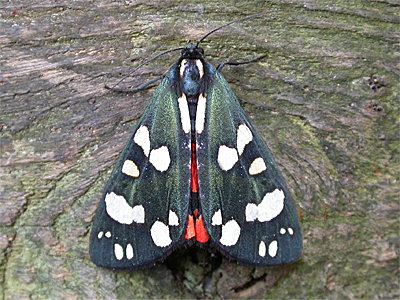
of migration Influxes of genuine migrants often contain some common species resident in the UK. Large Yellow Underwing, Turnip Moth, Angle Shades and Pale Mottled Willow are four moths often quoted in trap lists from coastal sites as being migrants. Other species such as Scarlet Tiger, have certainly appeared in Nottinghamshire during spells of hot and humid weather. But there are numerous other moths with resident UK populations, which probably often occur as genuine migrants along the UK south coast. These can sometimes be detected by their appearance at the light trap well out of season, or in some instances habitat. Determining just what is a genuine migrant can be hindered by occasional or partial second broods later in the year, which certainly happened during August and September 2006, so moth trappers should take this into consideration before they record some resident moths as genuine migrants. |
 |
|||
| ..... | ||||
| Our
Nottinghamshire migrant records This following list contains all our own migrant moth records since 2004. Scrolling through the listed records, will certainly give an insight into how each year is different for moth migration - either in numbers, or the particular species involved. For all monthly/yearly totals in table form, please click on the links below. Both pages are updated daily as and when required. |
| ... |
| Migrant occurrences by month 2000-2026 |
| Migrant occurrences by year 2000-2026 |
| 2026 Migrant moth records |
 |
| Species | Site | Date | Qty | Method | ||||||
| 69.010 Macroglossum stellatarum | 69.010 Macroglossum stellatarum | Macroglossum stellatarum | ||||||||
| 73.087 Spodoptera exigua | Small Mottled Willow | Kirton Wood | 05/10/26 | 8 | MV light | |||||
| 63.031 Udea ferrugalis | Rusty Dot Pearl | Kirton Wood | 05/10/26 | 1 | MV light | |||||
| 35.118 Scrobipalpa ocellatella | Kirton Wood | 05/10/26 | 2 | MV light | ||||||
| 63.052 Nomophila noctuella | Rush Veneer | Red Hill (Eakring) | 01/10/26 | 2 | Field record | |||||
| ... | ||||||||||
| 73.015 Autographa gamma | Silver Y | Market Warsop (Day St) | 26/09/26 | 1 | Field record | |||||
| 73.015 Autographa gamma | Silver Y | Market Warsop (Day St) | 26/09/26 | 3 | Ni Moth lure | |||||
| 63.052 Nomophila noctuella | Rush Veneer | Lound Wood, Eakring | 24/09/26 | 1 | MV light | |||||
| 35.118 Scrobipalpa ocellatella | Lound Wood, Eakring | 24/09/26 | 1 | MV light | ||||||
| 70.038 Rhodometra sacraria | Vestal | Misson Carr | 22/09/26 | 1 | MV light | |||||
| 73.327 Agrotis ipsilon | Dark Sword-grass | Misson Carr | 22/09/26 | 1 | MV light | |||||
| 73.015 Autographa gamma | Silver Y | 22/09/26 | 1 | MV light | ||||||
| 62.053 Ancylosis oblitella | Misson Carr | 22/09/26 | 2 | MV light | ||||||
| 35.118 Scrobipalpa ocellatella | Misson Carr | 22/09/26 | 9 | MV light | ||||||
| 63.052 Nomophila noctuella | Rush Veneer | Misson Carr | 22/09/26 | 4 | MV light | |||||
| 73.015 Autographa gamma | Silver Y | Red Hill (Eakring) | 22/09/26 | 1 | Field record | |||||
| 73.015 Autographa gamma | Silver Y | Clumber Park | 20/09/26 | 2 | Field record | |||||
| 73.015 Autographa gamma | Silver Y | Market Warsop (Day St) | 20/09/26 | 2 | Ni Moth lure | |||||
| 73.015 Autographa gamma | Silver Y | Market Warsop (Day St) | 18/09/26 | 2 | Ni Moth lure | |||||
| 73.015 Autographa gamma | Silver Y | Market Warsop (Day St) | 16/09/26 | 1 | MV light | |||||
| 62.053 Ancylosis oblitella | Besthorpe NR | 13/09/26 | 1 | MV light | ||||||
| 63.052 Nomophila noctuella | Rush Veneer | Besthorpe NR | 13/09/26 | 1 | MV light | |||||
| 70.038 Rhodometra sacraria | Vestal | Besthorpe NR | 13/09/26 | 1 | MV light | |||||
| 35.118 Scrobipalpa ocellatella | Besthorpe NR | 13/09/26 | 3 | MV light | ||||||
| 73.087 Spodoptera exigua | Small Mottled Willow | Besthorpe NR | 13/09/26 | 4 | MV light | |||||
| 73.297 Mythimna albipuncta | White-point | Besthorpe NR | 13/09/26 | 3 | MV light | |||||
| 73.015 Autographa gamma | Silver Y | Besthorpe NR | 13/09/26 | 5 | MV light | |||||
| 63.052 Nomophila noctuella | Rush Veneer | Mansfield Cemetery | 13/09/26 | 1 | Field record | |||||
| 73.015 Autographa gamma | Silver Y | Market Warsop (Day St) | 12/09/26 | 6 | Ni Moth lure | |||||
| 73.015 Autographa gamma | Silver Y | Market Warsop (Day St) | 11/09/26 | 1 | Ni Moth lure | |||||
| 69.010 Macroglossum stellatarum | Hummingbird Hawk-moth | Market Warsop (Day St) | 10/09/26 | 1 | Nectaring | |||||
| 73.015 Autographa gamma | Silver Y | Market Warsop (Day St) | 09/09/26 | 1 | Ni Moth lure | |||||
| 69.010 Macroglossum stellatarum | Hummingbird Hawk-moth | Market Warsop (Day St) | 08/09/26 | 4 | Nectaring | |||||
| 70.038 Rhodometra sacraria | Vestal | Sherwood Heath | 08/09/26 | 1 | Field record | |||||
| 73.015 Autographa gamma | Silver Y | Market Warsop (Day St) | 08/09/26 | 2 | Ni Moth lure | |||||
| 73.015 Autographa gamma | Silver Y | Market Warsop (Day St) | 07/09/26 | 2 | Ni Moth lure | |||||
| 69.010 Macroglossum stellatarum | Hummingbird Hawk-moth | Market Warsop (Day St) | 07/09/26 | 1 | Nectaring | |||||
| 70.038 Rhodometra sacraria | Vestal | Lound Wood, Eakring | 06/09/26 | 1 | MV light | |||||
| 63.052 Nomophila noctuella | Rush Veneer | Lound Wood, Eakring | 06/09/26 | 1 | MV light | |||||
| 18.001 Plutella xylostella | Diamond-back Moth | Lound Wood, Eakring | 06/09/26 | 1 | MV light | |||||
| 73.087 Spodoptera exigua | Small Mottled Willow | Lound Wood, Eakring | 06/09/26 | 3 | MV light | |||||
| 35.118 Scrobipalpa ocellatella | Lound Wood, Eakring | 06/09/26 | 4 | MV light | ||||||
| 73.015 Autographa gamma | Silver Y | Lound Wood, Eakring | 06/09/26 | 2 | MV light | |||||
| 69.010 Macroglossum stellatarum | Hummingbird Hawk-moth | Market Warsop (Day St) | 06/09/26 | 1 | Nectaring | |||||
| 69.010 Macroglossum stellatarum | Hummingbird Hawk-moth | Nottingham (Gretton Road) | 06/09/26 | 1 | Indoors | |||||
| 73.010 Macdunnoghia confusa | Dewick's Plusia | Market Warsop (Day St) | 05/09/26 | 1 | Ni Moth lure | |||||
| 73.015 Autographa gamma | Silver Y | Market Warsop (Day St) | 05/09/26 | 1 | Ni Moth lure | |||||
| 73.015 Autographa gamma | Silver Y | Market Warsop (Day St) | 04/09/26 | 1 | Ni Moth lure | |||||
| 73.015 Autographa gamma | Silver Y | Market Warsop (Day St) | 01/09/26 | 4 | Ni Moth lure | |||||
| ... | ||||||||||
| 63.031 Udea ferrugalis | Rusty Dot Pearl | Market Warsop (Day St) | 30/08/26 | 1 | Field record | |||||
| 73.015 Autographa gamma | Silver Y | Red Hill (Eakring) | 30/08/26 | 4 | Field record | |||||
| 73.015 Autographa gamma | Silver Y | Market Warsop (Day St) | 30/08/26 | 2 | Ni Moth lure | |||||
| 69.010 Macroglossum stellatarum | Hummingbird Hawk-moth | Market Warsop (Day St) | 27/08/26 | 1 | Nectaring | |||||
| 73.015 Autographa gamma | Silver Y | Market Warsop (Day St) | 27/08/26 | 2 | Ni Moth lure | |||||
| 73.087 Spodoptera exigua | Small Mottled Willow | Lound Wood, Eakring | 26/08/26 | 42 | MV light | |||||
| 63.052 Nomophila noctuella | Rush Veneer | Lound Wood, Eakring | 26/08/26 | 2 | MV light | |||||
| 73.015 Autographa gamma | Silver Y | Lound Wood, Eakring | 26/08/26 | 3 | MV light | |||||
| 18.001 Plutella xylostella | Diamond-back Moth | Lound Wood, Eakring | 26/08/26 | 1 | MV light | |||||
| 63.031 Udea ferrugalis | Rusty Dot Pearl | Lound Wood, Eakring | 26/08/26 | 1 | MV light | |||||
| 69.010 Macroglossum stellatarum | Hummingbird Hawk-moth | Market Warsop (Day St) | 26/08/26 | 1 | Nectaring | |||||
| 73.015 Autographa gamma | Silver Y | Market Warsop (Day St) | 26/08/26 | 6 | Ni Moth lure | |||||
| 69.010 Macroglossum stellatarum | Hummingbird Hawk-moth | Market Warsop (Day St) | 25/08/26 | 2 | Nectaring | |||||
| 73.010 Macdunnoghia confusa | Dewick's Plusia | Market Warsop (Day St) | 25/08/26 | 1 | Ni Moth lure | |||||
| 73.015 Autographa gamma | Silver Y | Market Warsop (Day St) | 25/08/26 | 4 | Ni Moth lure | |||||
| 69.010 Macroglossum stellatarum | Hummingbird Hawk-moth | Market Warsop (Day St) | 24/08/26 | 2 | Nectaring | |||||
| 69.010 Macroglossum stellatarum | Hummingbird Hawk-moth | Market Warsop (Day St) | 23/08/26 | 1 | Nectaring | |||||
| 73.015 Autographa gamma | Silver Y | Market Warsop (Day St) | 23/08/26 | 7 | Ni Moth lure | |||||
| 69.010 Macroglossum stellatarum | Hummingbird Hawk-moth | Market Warsop (Day St) | 22/08/26 | 3 | Nectaring | |||||
| 73.015 Autographa gamma | Silver Y | Market Warsop (Day St) | 22/08/26 | 3 | Ni Moth lure | |||||
| 73.015 Autographa gamma | Silver Y | Red Hill (Eakring) | 21/08/26 | 1 | Field record | |||||
| 63.052 Nomophila noctuella | Rush Veneer | Red Hill (Eakring) | 21/08/26 | 2 | Field record | |||||
| 73.015 Autographa gamma | Silver Y | Market Warsop (Day St) | 21/08/26 | 1 | Ni Moth lure | |||||
| 73.010 Macdunnoghia confusa | Dewick's Plusia | Market Warsop (Day St) | 21/08/26 | 1 | Ni Moth lure | |||||
| 73.015 Autographa gamma | Silver Y | Market Warsop (Day St) | 20/08/26 | 2 | Ni Moth lure | |||||
| 73.015 Autographa gamma | Silver Y | Market Warsop (Day St) | 19/08/26 | 2 | Ni Moth lure | |||||
| 69.010 Macroglossum stellatarum | Hummingbird Hawk-moth | Market Warsop (Day St) | 17/08/26 | 1 | Nectaring | |||||
| 69.010 Macroglossum stellatarum | Hummingbird Hawk-moth | Market Warsop (Day St) | 14/08/26 | 2 | Nectaring | |||||
| 69.010 Macroglossum stellatarum | Hummingbird Hawk-moth | Lambley | 14/08/26 | 1 | Nectaring | |||||
| 69.010 Macroglossum stellatarum | Hummingbird Hawk-moth | Lambley Cemetery | 14/08/26 | 1 | Field record | |||||
| 73.015 Autographa gamma | Silver Y | Market Warsop (Day St) | 13/08/26 | 1 | Ni Moth lure | |||||
| 69.010 Macroglossum stellatarum | Hummingbird Hawk-moth | Market Warsop (Day St) | 13/08/26 | 1 | Nectaring | |||||
| 69.010 Macroglossum stellatarum | Hummingbird Hawk-moth | Market Warsop (Day St) | 10/08/26 | 1 | Nectaring | |||||
| 73.015 Autographa gamma | Silver Y | Market Warsop (Day St) | 10/08/26 | 2 | Ni Moth lure | |||||
| 70.038 Rhodometra sacraria | Vestal | Gamston Wood | 09/08/26 | 1 | MV light | |||||
| 73.087 Spodoptera exigua | Small Mottled Willow | Gamston Wood | 09/08/26 | 7 | MV light | |||||
| 18.001 Plutella xylostella | Diamond-back Moth | Gamston Wood | 09/08/26 | 1 | MV light | |||||
| 35.118 Scrobipalpa ocellatella | Gamston Wood | 09/08/26 | 8 | MV light | ||||||
| 73.015 Autographa gamma | Silver Y | Market Warsop (Day St) | 09/08/26 | 2 | Ni Moth lure | |||||
| 73.010 Macdunnoghia confusa | Dewick's Plusia | Market Warsop (Day St) | 09/08/26 | 2 | Ni Moth lure | |||||
| 73.010 Macdunnoghia confusa | Dewick's Plusia | Market Warsop (Day St) | 08/08/26 | 1 | Field record | |||||
| 69.010 Macroglossum stellatarum | Hummingbird Hawk-moth | Market Warsop (Day St) | 08/08/26 | 1 | Nectaring | |||||
| 73.015 Autographa gamma | Silver Y | Market Warsop (Day St) | 08/08/26 | 3 | Ni Moth lure | |||||
| 73.015 Autographa gamma | Silver Y | Market Warsop (Day St) | 07/08/26 | 1 | Ni Moth lure | |||||
| 69.010 Macroglossum stellatarum | Hummingbird Hawk-moth | Market Warsop (Day St) | 06/08/26 | 1 | Nectaring | |||||
| 73.015 Autographa gamma | Silver Y | Market Warsop (Day St) | 06/08/26 | 1 | Ni Moth lure | |||||
| 73.010 Macdunnoghia confusa | Dewick's Plusia | Market Warsop (Day St) | 05/08/26 | 1 | Field record | |||||
| 69.010 Macroglossum stellatarum | Hummingbird Hawk-moth | Market Warsop (Day St) | 05/08/26 | 1 | Field record | |||||
| 73.015 Autographa gamma | Silver Y | Market Warsop (Day St) | 05/08/26 | 5 | Ni Moth lure | |||||
| 73.010 Macdunnoghia confusa | Dewick's Plusia | Market Warsop (Day St) | 05/08/26 | 1 | Ni Moth lure | |||||
| 73.010 Macdunnoghia confusa | Dewick's Plusia | Market Warsop (Day St) | 04/08/26 | 2 | Ni Moth lure | |||||
| 63.031 Udea ferrugalis | Rusty Dot Pearl | Besthorpe NR | 03/08/26 | 1 | MV light | |||||
| 73.015 Autographa gamma | Silver Y | Besthorpe NR | 03/08/26 | 2 | MV light | |||||
| 35.118 Scrobipalpa ocellatella | Besthorpe NR | 03/08/26 | 6 | MV light | ||||||
| 73.087 Spodoptera exigua | Small Mottled Willow | Besthorpe NR | 03/08/26 | 17 | MV light | |||||
| 73.297 Mythimna albipuncta | White-point | Besthorpe NR | 03/08/26 | 5 | MV light | |||||
| 69.010 Macroglossum stellatarum | Hummingbird Hawk-moth | Lound Wood, Eakring | 03/08/26 | 1 | Nectaring | |||||
| 73.010 Macdunnoghia confusa | Dewick's Plusia | Market Warsop (Day St) | 03/08/26 | 1 | Ni Moth lure | |||||
| 73.015 Autographa gamma | Silver Y | Market Warsop (Day St) | 03/08/26 | 3 | Ni Moth lure | |||||
| 73.297 Mythimna albipuncta | White-point | Lound Wood, Eakring | 02/08/26 | 1 | MV light | |||||
| 35.118 Scrobipalpa ocellatella | Lound Wood, Eakring | 02/08/26 | 8 | MV light | ||||||
| 69.010 Macroglossum stellatarum | Hummingbird Hawk-moth | Market Warsop (Day St) | 01/08/26 | 1 | Nectaring | |||||
| 73.015 Autographa gamma | Silver Y | Market Warsop (Day St) | 01/08/26 | 2 | Ni Moth lure | |||||
| ... | ||||||||||
| 69.010 Macroglossum stellatarum | Hummingbird Hawk-moth | Red Hill (Eakring) | 31/07/26 | 1 | Nectaring | |||||
| 69.010 Macroglossum stellatarum | Hummingbird Hawk-moth | Market Warsop (Day St) | 30/07/26 | 1 | Field record | |||||
| 18.001 Plutella xylostella | Diamond-back Moth | Market Warsop (Day St) | 30/07/26 | 1 | Field record | |||||
| 73.015 Autographa gamma | Silver Y | Market Warsop (Day St) | 30/07/26 | 2 | Ni Moth lure | |||||
| 73.010 Macdunnoghia confusa | Dewick's Plusia | Market Warsop (Day St) | 29/07/26 | 2 | Ni Moth lure | |||||
| 73.015 Autographa gamma | Silver Y | Market Warsop (Day St) | 29/07/26 | 1 | Ni Moth lure | |||||
| 69.010 Macroglossum stellatarum | Hummingbird Hawk-moth | Market Warsop (Day St) | 28/07/26 | 1 | Larva | |||||
| 70.038 Rhodometra sacraria | Vestal | Eakring Flash | 28/07/26 | 1 | Field record | |||||
| 73.015 Autographa gamma | Silver Y | Market Warsop (Day St) | 28/07/26 | 1 | Ni Moth lure | |||||
| 73.087 Spodoptera exigua | Small Mottled Willow | Kirton Wood | 27/07/26 | 1 | MV light | |||||
| 35.118 Scrobipalpa ocellatella | Kirton Wood | 27/07/26 | 1 | MV light | ||||||
| 73.015 Autographa gamma | Silver Y | Market Warsop (Day St) | 26/07/26 | 2 | Ni Moth lure | |||||
| 73.015 Autographa gamma | Silver Y | Market Warsop (Day St) | 25/07/26 | 2 | Ni Moth lure | |||||
| 69.010 Macroglossum stellatarum | Hummingbird Hawk-moth | Market Warsop (Day St) | 23/07/26 | 1 | Nectaring | |||||
| 73.015 Autographa gamma | Silver Y | Market Warsop (Day St) | 23/07/26 | 2 | Ni Moth lure | |||||
| 35.118 Scrobipalpa ocellatella | Lound Wood, Eakring | 22/07/26 | 9 | MV light | ||||||
| 73.015 Autographa gamma | Silver Y | Lound Wood, Eakring | 22/07/26 | 1 | MV light | |||||
| 73.087 Spodoptera exigua | Small Mottled Willow | Lound Wood, Eakring | 22/07/26 | 1 | MV light | |||||
| 18.001 Plutella xylostella | Diamond-back Moth | Lound Wood, Eakring | 22/07/26 | 1 | MV light | |||||
| 73.010 Macdunnoghia confusa | Dewick's Plusia | Market Warsop (Day St) | 22/07/26 | 1 | Ni Moth lure | |||||
| 73.015 Autographa gamma | Silver Y | Market Warsop (Day St) | 22/07/26 | 1 | Ni Moth lure | |||||
| 73.087 Spodoptera exigua | Small Mottled Willow | Misson Carr | 21/07/26 | 7 | MV light | |||||
| 35.118 Scrobipalpa ocellatella | Misson Carr | 21/07/26 | 19 | MV light | ||||||
| 18.001 Plutella xylostella | Diamond-back Moth | Misson Carr | 21/07/26 | 8 | MV light | |||||
| 73.297 Mythimna albipuncta | White-point | Misson Carr | 21/07/26 | 1 | MV light | |||||
| 73.015 Autographa gamma | Silver Y | Misson Carr | 21/07/26 | 3 | MV light | |||||
| 69.010 Macroglossum stellatarum | Hummingbird Hawk-moth | Market Warsop (Day St) | 21/07/26 | 1 | Nectaring | |||||
| 73.010 Macdunnoghia confusa | Dewick's Plusia | Market Warsop (Day St) | 21/07/26 | 1 | Ni Moth lure | |||||
| 73.015 Autographa gamma | Silver Y | Market Warsop (Day St) | 20/07/26 | 1 | Ni Moth lure | |||||
| 69.010 Macroglossum stellatarum | Hummingbird Hawk-moth | Market Warsop (Day St) | 20/07/26 | 2 | Nectaring | |||||
| 73.010 Macdunnoghia confusa | Dewick's Plusia | Market Warsop (Day St) | 19/07/26 | 1 | Ni Moth lure | |||||
| 73.015 Autographa gamma | Silver Y | Market Warsop (Day St) | 19/07/26 | 1 | Ni Moth lure | |||||
| 69.010 Macroglossum stellatarum | Hummingbird Hawk-moth | Market Warsop (Day St) | 18/07/26 | 1 | Nectaring | |||||
| 69.010 Macroglossum stellatarum | Hummingbird Hawk-moth | Market Warsop (Day St) | 17/07/26 | 1 | Field record | |||||
| 73.015 Autographa gamma | Silver Y | Market Warsop (Day St) | 17/07/26 | 1 | Ni Moth lure | |||||
| 73.010 Macdunnoghia confusa | Dewick's Plusia | Market Warsop (Day St) | 16/07/26 | 1 | Ni Moth lure | |||||
| 73.015 Autographa gamma | Silver Y | Market Warsop (Day St) | 15/07/26 | 3 | Ni Moth lure | |||||
| 69.010 Macroglossum stellatarum | Hummingbird Hawk-moth | Market Warsop (Day St) | 14/07/26 | 1 | Nectaring | |||||
| 73.015 Autographa gamma | Silver Y | Market Warsop (Day St) | 12/07/26 | 2 | Ni Moth lure | |||||
| 73.010 Macdunnoghia confusa | Dewick's Plusia | Market Warsop (Day St) | 12/07/26 | 2 | Ni Moth lure | |||||
| 73.010 Macdunnoghia confusa | Dewick's Plusia | Market Warsop (Day St) | 11/07/26 | 1 | Ni Moth lure | |||||
| 73.015 Autographa gamma | Silver Y | Market Warsop (Day St) | 11/07/26 | 4 | Ni Moth lure | |||||
| 18.001 Plutella xylostella | Diamond-back Moth | Market Warsop (Day St) | 10/07/26 | 1 | Field record | |||||
| 73.015 Autographa gamma | Silver Y | Lound Wood, Eakring | 10/07/26 | 1 | Field record | |||||
| 69.010 Macroglossum stellatarum | Hummingbird Hawk-moth | Lound Wood, Eakring | 10/07/26 | 1 | Field record | |||||
| 73.015 Autographa gamma | Silver Y | Market Warsop (Day St) | 10/07/26 | 2 | Ni Moth lure | |||||
| 73.015 Autographa gamma | Silver Y | Market Warsop (Day St) | 09/07/26 | 2 | Ni Moth lure | |||||
| 18.001 Plutella xylostella | Diamond-back Moth | Market Warsop (Day St) | 09/07/26 | 1 | Field record | |||||
| 73.015 Autographa gamma | Silver Y | Market Warsop (Day St) | 08/07/26 | 1 | Ni Moth lure | |||||
| 73.015 Autographa gamma | Silver Y | Market Warsop (Day St) | 06/07/26 | 2 | Ni Moth lure | |||||
| 69.010 Macroglossum stellatarum | Hummingbird Hawk-moth | Market Warsop (Day St) | 05/07/26 | 1 | Nectaring | |||||
| 69.010 Macroglossum stellatarum | Hummingbird Hawk-moth | Market Warsop (Day St) | 04/07/26 | 2 | Nectaring | |||||
| 69.010 Macroglossum stellatarum | Hummingbird Hawk-moth | Market Warsop (Day St) | 03/07/26 | 3 | Nectaring | |||||
| 18.001 Plutella xylostella | Diamond-back Moth | Market Warsop (Day St) | 02/07/26 | 1 | Field record | |||||
| 73.015 Autographa gamma | Silver Y | Market Warsop (Day St) | 01/07/26 | 2 | Ni Moth lure | |||||
| ... | ||||||||||
| 69.010 Macroglossum stellatarum | Hummingbird Hawk-moth | Market Warsop (Day St) | 29/06/26 | 1 | Nectaring | |||||
| 73.015 Autographa gamma | Silver Y | Market Warsop (Day St) | 29/06/26 | 1 | Ni Moth lure | |||||
| 73.015 Autographa gamma | Silver Y | Market Warsop (Day St) | 28/06/26 | 1 | Ni Moth lure | |||||
| 73.015 Autographa gamma | Silver Y | Market Warsop (Day St) | 26/06/26 | 1 | Field record | |||||
| 73.010 Macdunnoghia confusa | Dewick's Plusia | Lound Wood, Eakring | 24/06/26 | 1 | MV light | |||||
| 73.087 Spodoptera exigua | Small Mottled Willow | Lound Wood, Eakring | 24/06/26 | 1 | MV light | |||||
| 18.001 Plutella xylostella | Diamond-back Moth | Lound Wood, Eakring | 24/06/26 | 4 | MV light | |||||
| 73.015 Autographa gamma | Silver Y | Lound Wood, Eakring | 24/06/26 | 1 | MV light | |||||
| 73.015 Autographa gamma | Silver Y | Market Warsop (Day St) | 23/06/26 | 1 | Ni Moth lure | |||||
| 18.001 Plutella xylostella | Diamond-back Moth | Market Warsop (Day St) | 23/06/26 | 1 | Field record | |||||
| 69.010 Macroglossum stellatarum | Hummingbird Hawk-moth | Market Warsop (Day St) | 21/06/26 | 1 | Nectaring | |||||
| 18.001 Plutella xylostella | Diamond-back Moth | Besthorpe NR | 20/06/26 | 2 | MV light | |||||
| 73.297 Mythimna albipuncta | White-point | Besthorpe NR | 20/06/26 | 1 | MV light | |||||
| 73.015 Autographa gamma | Silver Y | Market Warsop (Day St) | 20/06/26 | 1 | Ni Moth lure | |||||
| 69.010 Macroglossum stellatarum | Hummingbird Hawk-moth | Market Warsop (Day St) | 18/06/26 | 1 | Nectaring | |||||
| 73.015 Autographa gamma | Silver Y | Market Warsop (Day St) | 18/06/26 | 2 | Ni Moth lure | |||||
| 18.001 Plutella xylostella | Diamond-back Moth | Market Warsop (Day St) | 19/06/26 | 1 | Field record | |||||
| 69.010 Macroglossum stellatarum | Hummingbird Hawk-moth | Market Warsop (Day St) | 18/06/26 | 1 | Nectaring | |||||
| 73.015 Autographa gamma | Silver Y | Market Warsop (Day St) | 18/06/26 | 3 | Ni Moth lure | |||||
| 73.015 Autographa gamma | Silver Y | Market Warsop (Day St) | 17/06/26 | 2 | Ni Moth lure | |||||
| 73.015 Autographa gamma | Silver Y | Market Warsop (Day St) | 16/06/26 | 6 | Ni Moth lure | |||||
| 73.015 Autographa gamma | Silver Y | Red Hill (Eakring) | 15/06/26 | 1 | Field record | |||||
| 73.015 Autographa gamma | Silver Y | Market Warsop (Day St) | 14/06/26 | 1 | Ni Moth lure | |||||
| 73.015 Autographa gamma | Silver Y | Market Warsop (Day St) | 13/06/26 | 3 | Ni Moth lure | |||||
| 73.015 Autographa gamma | Silver Y | Market Warsop (Day St) | 12/06/26 | 4 | Ni Moth lure | |||||
| 73.010 Macdunnoghia confusa | Dewick's Plusia | Market Warsop (Day St) | 12/06/26 | 1 | Ni Moth lure | |||||
| 73.015 Autographa gamma | Silver Y | Market Warsop (Day St) | 10/06/26 | 2 | Ni Moth lure | |||||
| 73.015 Autographa gamma | Silver Y | Market Warsop (Day St) | 09/06/26 | 4 | Ni Moth lure | |||||
| 18.001 Plutella xylostella | Diamond-back Moth | Market Warsop (Day St) | 09/06/26 | 1 | Field record | |||||
| 73.015 Autographa gamma | Silver Y | Market Warsop (Day St) | 08/06/26 | 5 | Ni Moth lure | |||||
| 69.010 Macroglossum stellatarum | Hummingbird Hawk-moth | Market Warsop (Day St) | 07/06/26 | 1 | Nectaring | |||||
| 69.010 Macroglossum stellatarum | Hummingbird Hawk-moth | Market Warsop (Day St) | 06/06/26 | 1 | Nectaring | |||||
| 73.015 Autographa gamma | Silver Y | Market Warsop (Day St) | 06/06/26 | 3 | Ni Moth lure | |||||
| 73.015 Autographa gamma | Silver Y | Market Warsop (Day St) | 05/06/26 | 3 | Nectaring | |||||
| 73.015 Autographa gamma | Silver Y | Market Warsop (Day St) | 05/06/26 | 1 | Ni Moth lure | |||||
| 73.015 Autographa gamma | Silver Y | Market Warsop (Day St) | 04/06/26 | 8 | Ni Moth lure | |||||
| 73.015 Autographa gamma | Silver Y | Market Warsop (Day St) | 03/06/26 | 3 | Ni Moth lure | |||||
| ... | ||||||||||
| 69.010 Macroglossum stellatarum | Hummingbird Hawk-moth | Market Warsop (Day St) | 31/05/26 | 1 | Nectaring | |||||
| 18.001 Plutella xylostella | Diamond-back Moth | Market Warsop (Day St) | 31/05/26 | 1 | Field record | |||||
| 18.001 Plutella xylostella | Diamond-back Moth | Misson Carr | 30/05/26 | 2 | MV light | |||||
| 73.297 Mythimna albipuncta | White-point | Misson Carr | 30/05/26 | 1 | MV light | |||||
| 73.015 Autographa gamma | Silver Y | Misson Carr | 30/05/26 | 1 | MV light | |||||
| 73.015 Autographa gamma | Silver Y | Market Warsop (Day St) | 30/05/26 | 5 | Ni Moth lure | |||||
| 73.015 Autographa gamma | Silver Y | Market Warsop (Day St) | 29/05/26 | 3 | Nectaring | |||||
| 18.001 Plutella xylostella | Diamond-back Moth | Clumber Park | 29/05/26 | 1 | Field record | |||||
| 73.015 Autographa gamma | Silver Y | Clumber Park | 29/05/26 | 3 | Ni Moth lure | |||||
| 73.015 Autographa gamma | Silver Y | Market Warsop (Day St) | 28/05/26 | 7 | Ni Moth lure | |||||
| 73.015 Autographa gamma | Silver Y | Market Warsop (Day St) | 27/05/26 | 1 | Ni Moth lure | |||||
| 73.015 Autographa gamma | Silver Y | Market Warsop (Day St) | 26/05/26 | 2 | Nectaring | |||||
| 18.001 Plutella xylostella | Diamond-back Moth | Market Warsop (Day St) | 26/05/26 | 2 | Field record | |||||
| 73.087 Spodoptera exigua | Small Mottled Willow | Lound Wood, Eakring | 25/05/26 | 1 | MV light | |||||
| 73.015 Autographa gamma | Silver Y | Lound Wood, Eakring | 25/05/26 | 3 | MV light | |||||
| 18.001 Plutella xylostella | Diamond-back Moth | Lound Wood, Eakring | 25/05/26 | 17 | MV light | |||||
| 69.010 Macroglossum stellatarum | Hummingbird Hawk-moth | Market Warsop (Day St) | 25/05/26 | 1 | Nectaring | |||||
| 73.015 Autographa gamma | Silver Y | Lound Wood, Eakring | 25/05/26 | 75 | Field record | |||||
| 73.010 Macdunnoghia confusa | Dewick's Plusia | Red Hill (Eakring) | 25/05/26 | 1 | MV light | |||||
| 73.297 Mythimna albipuncta | White-point | Red Hill (Eakring) | 24/05/26 | 2 | MV light | |||||
| 73.015 Autographa gamma | Silver Y | Market Warsop (Day St) | 24/05/26 | 1 | Ni Moth lure | |||||
| 73.015 Autographa gamma | Silver Y | Red Hill (Eakring) | 24/05/26 | 1 | MV light | |||||
| 18.001 Plutella xylostella | Diamond-back Moth | Red Hill (Eakring) | 24/05/26 | 29 | MV light | |||||
| 73.015 Autographa gamma | Silver Y | Red Hill (Eakring) | 24/05/26 | 1 | Field record | |||||
| 18.001 Plutella xylostella | Diamond-back Moth | Market Warsop (Day St) | 24/05/26 | 1 | Field record | |||||
| 73.015 Autographa gamma | Silver Y | Eakring Flash | 15/05/26 | 4 | Field record | |||||
| 73.015 Autographa gamma | Silver Y | Red Hill (Eakring) | 08/05/26 | 1 | Field record | |||||
| 73.015 Autographa gamma | Silver Y | Red Hill (Eakring) | 05/05/26 | 2 | Field record | |||||
| 73.015 Autographa gamma | Silver Y | Besthorpe NR | 01/05/26 | 1 | MV light | |||||
| ... | ||||||||||
| 73.010 Macdunnoghia confusa | Dewick's Plusia | Market Warsop (Day St) | 30/04/26 | 1 | Ni Moth lure | |||||
| 18.001 Plutella xylostella | Diamond-back Moth | Lound Wood, Eakring | 26/04/26 | 4 | MV light | |||||
| 73.015 Autographa gamma | Silver Y | Red Hill (Eakring) | 26/04/26 | 1 | Field record | |||||
| 18.001 Plutella xylostella | Diamond-back Moth | Clipstone Old Quarter | 19/04/26 | 1 | Field record | |||||
| 18.001 Plutella xylostella | Diamond-back Moth | Treswell Wood | 16/04/26 | 3 | MV light | |||||
| 18.001 Plutella xylostella | Diamond-back Moth | Misson Carr | 08/04/26 | 1 | MV light | |||||
| 2025 Migrant moth records |
|
| Species | Site | Date | Qty | Method | ||||||
| 69.010 Macroglossum stellatarum | 69.010 Macroglossum stellatarum | 69.010 Macroglossum stellatarum | ||||||||
| 73.076 Helicoverpa armigera | Scarce Bordered Straw | Besthorpe NR | 06/11/25 | 1 | MV light | |||||
| 73.297 Mythimna albipuncta | White-point | Besthorpe NR | 06/11/25 | 2 | MV light | |||||
| 18.001 Plutella xylostella | Diamond-back Moth | Besthorpe NR | 06/11/25 | 1 | MV light | |||||
| 63.031 Udea ferrugalis | Rusty Dot Pearl | Besthorpe NR | 06/11/25 | 1 | MV light | |||||
| ..... | ||||||||||
| 73.076 Helicoverpa armigera | Scarce Bordered Straw | Lound Wood, Eakring | 18/10/25 | 1 | MV light | |||||
| 73.015 Autographa gamma | Silver Y | Red Hill, Eakring | 10/10/25 | 1 | Field record | |||||
| 35.118 Scrobipalpa ocellatella | Besthorpe NR | 01/10/25 | 4 | MV light | ||||||
| 73.297 Mythimna albipuncta | White-point | Besthorpe NR | 01/10/25 | 5 | MV light | |||||
| ..... | ||||||||||
| 73.015 Autographa gamma | Silver Y | Lound Wood, Eakring | 29/09/25 | 3 | MV light | |||||
| 73.015 Autographa gamma | Silver Y | Red Hill, Eakring | 29/09/25 | 1 | Field record | |||||
| 73.015 Autographa gamma | Silver Y | Lound Wood, Eakring | 29/09/25 | 4 | Field record | |||||
| 63.052 Nomophila noctuella | Rush Veneer | Eakring | 25/09/25 | 1 | Field record | |||||
| 69.010 Macroglossum stellatarum | Hummingbird Hawk-moth | Lound Wood, Eakring | 21/09/25 | 1 | Field record | |||||
| 73.015 Autographa gamma | Silver Y | Lound Wood, Eakring | 21/09/25 | 1 | Field record | |||||
| 73.074 Heliothis peltigera | Bordered Straw | Lound Wood, Eakring | 19/09/25 | 1 | MV light | |||||
| 73.076 Helicoverpa armigera | Scarce Bordered Straw | Lound Wood, Eakring | 19/09/25 | 2 | MV light | |||||
| 70.038 Rhodometra sacraria | Vestal | Lound Wood, Eakring | 19/09/25 | 1 | MV light | |||||
| 73.010 Macdunnoghia confusa | Dewick's Plusia | Lound Wood, Eakring | 19/09/25 | 2 | MV light | |||||
| 73.015 Autographa gamma | Silver Y | Lound Wood, Eakring | 19/09/25 | 5 | MV light | |||||
| 18.001 Plutella xylostella | Diamond-back Moth | Lound Wood, Eakring | 19/09/25 | 1 | MV light | |||||
| 35.118 Scrobipalpa ocellatella | Lound Wood, Eakring | 19/09/25 | 5 | MV light | ||||||
| 63.052 Nomophila noctuella | Rush Veneer | Lound Wood, Eakring | 17/09/25 | 1 | MV light | |||||
| 63.031 Udea ferrugalis | Rusty Dot Pearl | Lound Wood, Eakring | 06/09/25 | 1 | MV light | |||||
| 69.010 Macroglossum stellatarum | Hummingbird Hawk-moth | Bevercotes Pit Wood | 02/09/25 | 2 | Nectaring | |||||
| 73.015 Autographa gamma | Silver Y | Bevercotes Pit Wood | 02/09/25 | 1 | Field record | |||||
| ..... | ||||||||||
| 63.031 Udea ferrugalis | Rusty Dot Pearl | Besthorpe NR | 26/08/25 | 1 | MV light | |||||
| 73.010 Macdunnoghia confusa | Dewick's Plusia | Besthorpe NR | 26/08/25 | 1 | MV light | |||||
| 63.048 Palpita vitrealis | Besthorpe NR | 26/08/25 | 1 | MV light | ||||||
| 73.297 Mythimna albipuncta | White-point | Besthorpe NR | 26/08/25 | 10 | MV light | |||||
| 35.118 Scrobipalpa ocellatella | Besthorpe NR | 26/08/25 | 14 | MV light | ||||||
| 73.074 Heliothis peltigera | Bordered Straw | Misson Carr | 23/08/25 | 1 | MV light | |||||
| 63.052 Nomophila noctuella | Rush Veneer | Misson Carr | 23/08/25 | 1 | MV light | |||||
| 35.118 Scrobipalpa ocellatella | Misson Carr | 23/08/25 | 4 | MV light | ||||||
| 73.297 Mythimna albipuncta | White-point | Misson Carr | 23/08/25 | 3 | MV light | |||||
| 73.297 Mythimna albipuncta | White-point | Lound Wood, Eakring | 19/08/25 | 1 | MV light | |||||
| 69.010 Macroglossum stellatarum | Hummingbird Hawk-moth | Market Warsop (Day St) | 16/08/25 | 1 | Nectaring | |||||
| 69.010 Macroglossum stellatarum | Hummingbird Hawk-moth | Market Warsop (Day St) | 15/08/25 | 1 | Larva | |||||
| 73.327 Agrotis ipsilon | Dark Sword-grass | Red Hill, Eakring | 12/08/25 | 1 | MV light | |||||
| 73.297 Mythimna albipuncta | White-point | Red Hill, Eakring | 12/08/25 | 3 | MV light | |||||
| 18.001 Plutella xylostella | Diamond-back Moth | Red Hill, Eakring | 12/08/25 | 2 | MV light | |||||
| 35.118 Scrobipalpa ocellatella | Red Hill, Eakring | 12/08/25 | 13 | MV light | ||||||
| 73.087 Spodoptera exigua | Small Mottled Willow | Lound Wood, Eakring | 10/08/25 | 1 | MV light | |||||
| 73.010 Macdunnoghia confusa | Dewick's Plusia | Lound Wood, Eakring | 10/08/25 | 1 | MV light | |||||
| 35.118 Scrobipalpa ocellatella | Lound Wood, Eakring | 10/08/25 | 11 | MV light | ||||||
| 18.001 Plutella xylostella | Diamond-back Moth | Lound Wood, Eakring | 10/08/25 | 3 | MV light | |||||
| 73.297 Mythimna albipuncta | White-point | Lound Wood, Eakring | 10/08/25 | 2 | MV light | |||||
| 69.010 Macroglossum stellatarum | Hummingbird Hawk-moth | Lound Wood, Eakring | 10/08/25 | 3 | Field record | |||||
| 73.015 Autographa gamma | Silver Y | Market Warsop (Day St) | 07/08/25 | 1 | Ni Moth lure | |||||
| 69.010 Macroglossum stellatarum | Hummingbird Hawk-moth | Lound Wood, Eakring | 06/08/25 | 1 | Nectaring | |||||
| 73.015 Autographa gamma | Silver Y | Lound Wood, Eakring | 06/08/25 | 1 | Field record | |||||
| ..... | ||||||||||
| 70.038 Rhodometra sacraria | Vestal | Besthorpe NR | 30/07/25 | 1 | MV light | |||||
| 73.297 Mythimna albipuncta | White-point | Besthorpe NR | 30/07/25 | 7 | MV light | |||||
| 18.001 Plutella xylostella | Diamond-back Moth | Besthorpe NR | 30/07/25 | 1 | MV light | |||||
| 73.015 Autographa gamma | Silver Y | Besthorpe NR | 30/07/25 | 2 | MV light | |||||
| 69.010 Macroglossum stellatarum | Hummingbird Hawk-moth | Market Warsop (Day St) | 28/07/25 | 1 | Larva | |||||
| 73.015 Autographa gamma | Silver Y | Lound Wood, Eakring | 24/07/25 | 1 | MV light | |||||
| 18.001 Plutella xylostella | Diamond-back Moth | Lound Wood, Eakring | 24/07/25 | 7 | MV light | |||||
| 73.015 Autographa gamma | Silver Y | Market Warsop (Day St) | 22/07/25 | 1 | Ni Moth lure | |||||
| 73.015 Autographa gamma | Silver Y | Market Warsop (Day St) | 21/07/25 | 1 | Ni Moth lure | |||||
| 73.015 Autographa gamma | Silver Y | Market Warsop (Day St) | 20/07/25 | 2 | Ni Moth lure | |||||
| 73.015 Autographa gamma | Silver Y | Misson Carr | 19/07/25 | 1 | MV light | |||||
| 18.001 Plutella xylostella | Diamond-back Moth | Misson Carr | 19/07/25 | 2 | MV light | |||||
| 73.010 Macdunnoghia confusa | Dewick's Plusia | Market Warsop (Day St) | 19/07/25 | 1 | Ni Moth lure | |||||
| 73.015 Autographa gamma | Silver Y | Market Warsop (Day St) | 19/07/25 | 1 | Ni Moth lure | |||||
| 69.010 Macroglossum stellatarum | Hummingbird Hawk-moth | Market Warsop (Day St) | 18/07/25 | 1 | Nectaring | |||||
| 73.015 Autographa gamma | Silver Y | Market Warsop (Day St) | 18/07/25 | 2 | Ni Moth lure | |||||
| 73.015 Autographa gamma | Silver Y | Market Warsop (Day St) | 17/07/25 | 3 | Nectaring | |||||
| 73.015 Autographa gamma | Silver Y | Market Warsop (Day St) | 17/07/25 | 1 | Ni Moth lure | |||||
| 73.015 Autographa gamma | Silver Y | Market Warsop (Day St) | 16/07/25 | 5 | Ni Moth lure | |||||
| 73.015 Autographa gamma | Silver Y | Market Warsop (Day St) | 15/07/25 | 4 | Ni Moth lure | |||||
| 73.010 Macdunnoghia confusa | Dewick's Plusia | Market Warsop (Day St) | 15/07/25 | 1 | Ni Moth lure | |||||
| 73.015 Autographa gamma | Silver Y | Market Warsop (Day St) | 14/07/25 | 4 | Ni Moth lure | |||||
| 73.015 Autographa gamma | Silver Y | Market Warsop (Day St) | 13/07/25 | 5 | Ni Moth lure | |||||
| 73.015 Autographa gamma | Silver Y | Market Warsop (Day St) | 12/07/25 | 5 | Ni Moth lure | |||||
| 73.010 Macdunnoghia confusa | Dewick's Plusia | Market Warsop (Day St) | 12/07/25 | 1 | Ni Moth lure | |||||
| 73.015 Autographa gamma | Silver Y | Market Warsop (Day St) | 11/07/25 | 1 | Ni Moth lure | |||||
| 35.118 Scrobipalpa ocellatella | Red Hill (Eakring) | 10/07/25 | 1 | MV light | ||||||
| 73.015 Autographa gamma | Silver Y | Red Hill (Eakring) | 10/07/25 | 2 | MV light | |||||
| 18.001 Plutella xylostella | Diamond-back Moth | Red Hill (Eakring) | 10/07/25 | 2 | MV light | |||||
| 73.327 Agrotis ipsilon | Dark Sword-grass | Red Hill (Eakring) | 10/07/25 | 1 | MV light | |||||
| 73.015 Autographa gamma | Silver Y | Market Warsop (Day St) | 09/07/25 | 10 | Ni Moth lure | |||||
| 73.015 Autographa gamma | Silver Y | Market Warsop (Day St) | 08/07/25 | 6 | Ni Moth lure | |||||
| 73.015 Autographa gamma | Silver Y | Market Warsop (Day St) | 07/07/25 | 9 | Ni Moth lure | |||||
| 73.015 Autographa gamma | Silver Y | Market Warsop (Day St) | 05/07/25 | 5 | Ni Moth lure | |||||
| 73.015 Autographa gamma | Silver Y | Market Warsop (Day St) | 04/07/25 | 2 | Ni Moth lure | |||||
| 73.015 Autographa gamma | Silver Y | Market Warsop (Day St) | 03/07/25 | 4 | Ni Moth lure | |||||
| 73.015 Autographa gamma | Silver Y | Market Warsop (Day St) | 02/07/25 | 1 | Ni Moth lure | |||||
| ..... | ||||||||||
| 69.010 Macroglossum stellatarum | Hummingbird Hawk-moth | Nottingham (Gretton Road) | 30/06/25 | 1 | Nectaring | |||||
| 73.015 Autographa gamma | Silver Y | Market Warsop (Day St) | 30/06/25 | 1 | Ni Moth lure | |||||
| 73.074 Heliothis peltigera | Bordered Straw | Lound Wood, Eakring | 29/06/25 | 1 | MV light | |||||
| 18.001 Plutella xylostella | Diamond-back Moth | Lound Wood, Eakring | 29/06/25 | 3 | MV light | |||||
| 69.010 Macroglossum stellatarum | Hummingbird Hawk-moth | Lound Wood, Eakring | 29/06/25 | 1 | Nectaring | |||||
| 69.010 Macroglossum stellatarum | Hummingbird Hawk-moth | Market Warsop (Day St) | 29/06/25 | 1 | Nectaring | |||||
| 73.015 Autographa gamma | Silver Y | Market Warsop (Day St) | 29/06/25 | 1 | Ni Moth lure | |||||
| 73.015 Autographa gamma | Silver Y | Market Warsop (Day St) | 28/06/25 | 3 | Ni Moth lure | |||||
| 69.010 Macroglossum stellatarum | Hummingbird Hawk-moth | Market Warsop (Day St) | 27/06/25 | 1 | Nectaring | |||||
| 73.015 Autographa gamma | Silver Y | Market Warsop (Day St) | 27/06/25 | 5 | Ni Moth lure | |||||
| 69.010 Macroglossum stellatarum | Hummingbird Hawk-moth | Market Warsop (Day St) | 26/06/25 | 2 | Nectaring | |||||
| 69.010 Macroglossum stellatarum | Hummingbird Hawk-moth | Lound Wood, Eakring | 26/06/25 | 1 | Field record | |||||
| 73.015 Autographa gamma | Silver Y | Market Warsop (Day St) | 23/06/25 | 2 | Ni Moth lure | |||||
| 73.015 Autographa gamma | Silver Y | Market Warsop (Day St) | 22/06/25 | 1 | Ni Moth lure | |||||
| 73.015 Autographa gamma | Silver Y | Market Warsop (Day St) | 21/06/25 | 3 | Ni Moth lure | |||||
| 18.001 Plutella xylostella | Diamond-back Moth | Lound Wood, Eakring | 18/06/25 | 5 | MV light | |||||
| 69.010 Macroglossum stellatarum | Hummingbird Hawk-moth | Market Warsop (Burns Lane) | 15/06/25 | 2 | Nectaring | |||||
| 73.015 Autographa gamma | Silver Y | Market Warsop (Day St) | 14/06/25 | 1 | Ni Moth lure | |||||
| 73.015 Autographa gamma | Silver Y | Red Hill (Eakring) | 13/06/25 | 2 | MV light | |||||
| 73.015 Autographa gamma | Silver Y | Market Warsop (Day St) | 12/06/25 | 4 | Ni Moth lure | |||||
| 73.015 Autographa gamma | Silver Y | Market Warsop (Day St) | 11/06/25 | 1 | Ni Moth lure | |||||
| 73.015 Autographa gamma | Silver Y | Market Warsop (Day St) | 08/06/25 | 2 | Ni Moth lure | |||||
| 73.015 Autographa gamma | Silver Y | Market Warsop (Day St) | 05/06/25 | 1 | Ni Moth lure | |||||
| 73.015 Autographa gamma | Silver Y | Market Warsop (Day St) | 04/06/25 | 1 | Nectaring | |||||
| 73.015 Autographa gamma | Silver Y | Market Warsop (Day St) | 04/06/25 | 5 | Ni Moth lure | |||||
| 73.015 Autographa gamma | Silver Y | Market Warsop (Day St) | 03/06/25 | 1 | Ni Moth lure | |||||
| 73.015 Autographa gamma | Silver Y | Market Warsop (Day St) | 02/06/25 | 2 | Ni Moth lure | |||||
| ..... | ||||||||||
| 73.015 Autographa gamma | Silver Y | Market Warsop (Day St) | 30/05/25 | 1 | Ni Moth lure | |||||
| 73.297 Mythimna albipuncta | White-point | Besthorpe NR | 30/05/25 | 1 | MV light | |||||
| 73.015 Autographa gamma | Silver Y | Market Warsop (Day St) | 28/05/25 | 1 | MV light | |||||
| 73.015 Autographa gamma | Silver Y | Market Warsop (Day St) | 28/05/25 | 1 | Ni Moth lure | |||||
| 73.015 Autographa gamma | Silver Y | Market Warsop (Day St) | 27/05/25 | 1 | Ni Moth lure | |||||
| 73.015 Autographa gamma | Silver Y | Market Warsop (Day St) | 22/05/25 | 1 | Ni Moth lure | |||||
| 73.015 Autographa gamma | Silver Y | Market Warsop (Day St) | 21/05/25 | 1 | Ni Moth lure | |||||
| 73.015 Autographa gamma | Silver Y | Market Warsop (Day St) | 19/05/25 | 1 | Ni Moth lure | |||||
| 73.015 Autographa gamma | Silver Y | Market Warsop (Day St) | 16/05/25 | 1 | Ni Moth lure | |||||
| 2024 Migrant moth records |
|
| Species | Site | Date | Qty | Method | ||||||
| 69.010 Macroglossum stellatarum | 69.010 Macroglossum stellatarum | 69.010 Macroglossum stellatarum | ||||||||
| 18.001 Plutella xylostella | Diamond-back Moth | Treswell Wood | 15/12/24 | 2 | MV light | |||||
| ..... | ||||||||||
| 73.015 Autographa gamma | Silver Y | Sherwood Forest | 30/11/24 | 1 | MV light | |||||
| ..... | ||||||||||
| 73.015 Autographa gamma | Silver Y | Sherwood Heath | 11/11/24 | 1 | Field record | |||||
| 18.001 Plutella xylostella | Diamond-back Moth | Gamston Wood | 02/11/24 | 1 | MV light | |||||
| ..... | ||||||||||
| 18.001 Plutella xylostella | Diamond-back Moth | Market Warsop (Day St) | 29/10/24 | 1 | MV light | |||||
| 18.001 Plutella xylostella | Diamond-back Moth | Market Warsop (Day St) | 16/10/24 | 1 | MV light | |||||
| ..... | ||||||||||
| 73.297 Mythimna albipuncta | White-point | Besthorpe GP | 18/09/24 | 2 | MV light | |||||
| 73.297 Mythimna albipuncta | White-point | Misson Carr | 19/09/24 | 1 | MV light | |||||
| 18.001 Plutella xylostella | Diamond-back Moth | Market Warsop (Day St) | 08/09/24 | 5 | MV light | |||||
| 18.001 Plutella xylostella | Diamond-back Moth | Market Warsop (Day St) | 07/09/24 | 1 | MV light | |||||
| 18.001 Plutella xylostella | Diamond-back Moth | Lound Wood, Eakring | 06/09/24 | 1 | MV light | |||||
| 73.297 Mythimna albipuncta | White-point | Lound Wood, Eakring | 06/09/24 | 1 | MV light | |||||
| 73.297 Mythimna albipuncta | White-point | Besthorpe GP | 02/09/24 | 4 | MV light | |||||
| ..... | ||||||||||
| 73.297 Mythimna albipuncta | White-point | Misson Carr | 26/08/24 | 3 | MV light | |||||
| 73.015 Autographa gamma | Silver Y | Market Warsop (Day St) | 25/08/24 | 2 | Field record | |||||
| 73.015 Autographa gamma | Silver Y | Market Warsop (Day St) | 20/08/24 | 3 | Ni Moth lure | |||||
| 73.015 Autographa gamma | Silver Y | Market Warsop (Day St) | 19/08/24 | 2 | Ni Moth lure | |||||
| 73.015 Autographa gamma | Silver Y | Market Warsop (Day St) | 17/08/24 | 1 | Ni Moth lure | |||||
| 73.015 Autographa gamma | Silver Y | Market Warsop (Day St) | 10/08/24 | 1 | MV light | |||||
| 73.015 Autographa gamma | Silver Y | Market Warsop (Day St) | 08/08/24 | 1 | Ni Moth lure | |||||
| ..... | ||||||||||
| 73.015 Autographa gamma | Silver Y | Lound Wood, Eakring | 31/07/24 | 2 | MV light | |||||
| 73.010 Macdunnoghia confusa | Dewick's Plusia | Market Warsop (Day St) | 31/07/24 | 1 | Ni Moth lure | |||||
| 73.015 Autographa gamma | Silver Y | Market Warsop (Day St) | 31/07/24 | 1 | Ni Moth lure | |||||
| 73.015 Autographa gamma | Silver Y | Market Warsop (Day St) | 30/07/24 | 3 | MV light | |||||
| 18.001 Plutella xylostella | Diamond-back Moth | Market Warsop (Day St) | 30/07/24 | 1 | MV light | |||||
| 18.001 Plutella xylostella | Diamond-back Moth | Market Warsop (Day St) | 29/07/24 | 1 | Field record | |||||
| 73.015 Autographa gamma | Silver Y | Market Warsop (Day St) | 29/07/24 | 3 | Nectaring | |||||
| 73.015 Autographa gamma | Silver Y | Clumber Park | 28/07/24 | 3 | Field record | |||||
| 73.015 Autographa gamma | Silver Y | Market Warsop (Day St) | 27/07/24 | 1 | Ni Moth lure | |||||
| 18.001 Plutella xylostella | Diamond-back Moth | Market Warsop (Day St) | 26/07/24 | 1 | MV light | |||||
| 73.015 Autographa gamma | Silver Y | Market Warsop (Day St) | 26/07/24 | 2 | MV light | |||||
| 73.015 Autographa gamma | Silver Y | Sherwood Forest | 26/07/24 | 1 | Field record | |||||
| 18.001 Plutella xylostella | Diamond-back Moth | Market Warsop (Day St) | 26/07/24 | 1 | Field record | |||||
| 18.001 Plutella xylostella | Diamond-back Moth | Gamston Wood | 23/07/24 | 1 | MV light | |||||
| 18.001 Plutella xylostella | Diamond-back Moth | Sherwood Forest | 19/07/24 | 2 | MV light | |||||
| 18.001 Plutella xylostella | Diamond-back Moth | Market Warsop (Day St) | 18/07/24 | 5 | MV light | |||||
| 18.001 Plutella xylostella | Diamond-back Moth | Lound Wood, Eakring | 17/07/24 | 7 | MV light | |||||
| 73.015 Autographa gamma | Silver Y | Misson Carr | 13/07/24 | 1 | MV light | |||||
| 73.015 Autographa gamma | Silver Y | Market Warsop (Day St) | 12/07/24 | 1 | Ni Moth lure | |||||
| 18.001 Plutella xylostella | Diamond-back Moth | Market Warsop (Day St) | 09/07/24 | 2 | MV light | |||||
| 73.015 Autographa gamma | Silver Y | Market Warsop (Day St) | 09/07/24 | 3 | MV light | |||||
| 73.015 Autographa gamma | Silver Y | Market Warsop (Day St) | 06/07/24 | 1 | Ni Moth lure | |||||
| 18.001 Plutella xylostella | Diamond-back Moth | Market Warsop (Day St) | 05/07/24 | 1 | Field record | |||||
| 73.015 Autographa gamma | Silver Y | Budby SF | 04/07/24 | 1 | Field record | |||||
| 73.015 Autographa gamma | Silver Y | Market Warsop (Day St) | 03/07/24 | 1 | Ni Moth lure | |||||
| ..... | ||||||||||
| 18.001 Plutella xylostella | Diamond-back Moth | Market Warsop (Day St) | 30/06/24 | 1 | MV light | |||||
| 73.015 Autographa gamma | Silver Y | Market Warsop (Day St) | 29/06/24 | 1 | Ni Moth lure | |||||
| 73.015 Autographa gamma | Silver Y | Clipstone Old Quarter | 26/06/24 | 1 | Field record | |||||
| 73.015 Autographa gamma | Silver Y | Market Warsop (Day St) | 25/06/24 | 1 | Ni Moth lure | |||||
| 73.015 Autographa gamma | Silver Y | Market Warsop (Day St) | 24/06/24 | 1 | Ni Moth lure | |||||
| 18.001 Plutella xylostella | Diamond-back Moth | Lound Wood, Eakring | 22/06/24 | 1 | MV light | |||||
| ..... | ||||||||||
| 73.015 Autographa gamma | Silver Y | Hills and Holes | 27/05/24 | 1 | Field record | |||||
| 73.015 Autographa gamma | Silver Y | Thoresby Pit Top | 25/05/24 | 1 | Field record | |||||
| 73.015 Autographa gamma | Silver Y | Clipstone Old Quarter | 17/05/24 | 14 | Field record | |||||
| 73.015 Autographa gamma | Silver Y | Warsop Main Pit Top | 15/05/24 | 1 | Field record | |||||
| 73.015 Autographa gamma | Silver Y | Market Warsop (Stonebridge Ln) | 11/05/24 | 1 | Field record | |||||
| 73.015 Autographa gamma | Silver Y | Nottingham (Gretton Rd) | 08/05/24 | 1 | Field record | |||||
| 73.015 Autographa gamma | Silver Y | Ransom Wood | 05/05/24 | 1 | MV light | |||||
| 73.015 Autographa gamma | Silver Y | Laxton (Acre Edge Rd) | 02/05/24 | 2 | Field record | |||||
| 73.015 Autographa gamma | Silver Y | Wellow Park | 01/05/24 | 1 | Field record | |||||
| 2023 Migrant moth records |
|
| Species | Site | Date | Qty | Method | ||||||
| 69.010 Macroglossum stellatarum | 69.010 Macroglossum stellatarum | 69.010 Macroglossum stellatarum | ||||||||
| 35.118 Scrobipalpa ocellatella | Lound Wood, Eakring | 08/10/23 | 1 | MV light | ||||||
| 1403a .Duponchelia fovealis | Market Warsop (Day St) | 08/10/23 | 1 | MV light | ||||||
| 73.010 Macdunnoghia confusa | Dewick's Plusia | Market Warsop (Day St) | 06/10/23 | 1 | MV light | |||||
| 69.010 Macroglossum stellatarum | Hummingbird Hawk-moth | Market Warsop (Day St) | 04/10/23 | 1 | Field record | |||||
| 73.010 Macdunnoghia confusa | Dewick's Plusia | Market Warsop (Day St) | 01/10/23 | 1 | MV light | |||||
| 73.015 Autographa gamma | Silver Y | Market Warsop (Day St) | 01/10/23 | 4 | MV light | |||||
| ..... | ||||||||||
| 73.015 Autographa gamma | Silver Y | Market Warsop (Day St) | 23/09/23 | 2 | MV light | |||||
| 73.015 Autographa gamma | Silver Y | Sherwood Heath | 22/09/23 | 1 | Field record | |||||
| 73.015 Autographa gamma | Silver Y | Market Warsop (Day St) | 17/09/23 | 2 | MV light | |||||
| 73.015 Autographa gamma | Silver Y | Market Warsop (Day St) | 16/09/23 | 4 | MV light | |||||
| 35.118 Scrobipalpa ocellatella | Market Warsop (Day St) | 16/09/23 | 1 | MV light | ||||||
| 73.297 Mythimna albipuncta | White-point | Market Warsop (Day St) | 16/09/23 | 1 | MV light | |||||
| 73.015 Autographa gamma | Silver Y | Market Warsop (Day St) | 10/09/23 | 2 | MV light | |||||
| 73.015 Autographa gamma | Silver Y | Market Warsop (Day St) | 09/09/23 | 1 | MV light | |||||
| 69.010 Macroglossum stellatarum | Hummingbird Hawk-moth | Market Warsop (Day St) | 08/09/23 | 1 | Larva | |||||
| 73.015 Autographa gamma | Silver Y | Market Warsop (Day St) | 08/09/23 | 2 | MV light | |||||
| 73.327 Agrotis ipsilon | Dark Sword-grass | Market Warsop (Day St) | 06/09/23 | 1 | MV light | |||||
| 73.015 Autographa gamma | Silver Y | Market Warsop (Day St) | 06/09/23 | 1 | MV light | |||||
| 73.015 Autographa gamma | Silver Y | Market Warsop (Day St) | 06/09/23 | 2 | Nectaring | |||||
| 63.031 Udea ferrugalis | Rusty Dot Pearl | Ransom Wood | 01/09/23 | 1 | MV light | |||||
| ..... | ||||||||||
| 69.010 Macroglossum stellatarum | Hummingbird Hawk-moth | Market Warsop (Day St) | 26/08/23 | 1 | Nectaring | |||||
| 73.015 Autographa gamma | Silver Y | Market Warsop (Day St) | 23/08/23 | 4 | MV light | |||||
| 35.118 Scrobipalpa ocellatella | Lound Wood, Eakring | 20/08/23 | 1 | MV light | ||||||
| 18.001 Plutella xylostella | Diamond-back Moth | Lound Wood, Eakring | 20/08/23 | 1 | MV light | |||||
| 73.015 Autographa gamma | Silver Y | Misson Carr | 16/08/23 | 3 | MV light | |||||
| 18.001 Plutella xylostella | Diamond-back Moth | Misson Carr | 04/08/23 | 1 | MV light | |||||
| ..... | ||||||||||
| 69.010 Macroglossum stellatarum | Hummingbird Hawk-moth | Market Warsop (Day St) | 29/07/23 | 1 | Nectaring | |||||
| 73.015 Autographa gamma | Silver Y | Misson Carr | 24/07/23 | 5 | MV light | |||||
| 73.015 Autographa gamma | Silver Y | Warsop Main Pit Top | 17/07/23 | 3 | Field record | |||||
| 73.015 Autographa gamma | Silver Y | Clipstone Old Quarter | 15/07/23 | 1 | Field record | |||||
| 73.015 Autographa gamma | Silver Y | Clumber Park | 13/07/23 | 2 | Field record | |||||
| 73.015 Autographa gamma | Silver Y | Misson Carr | 07/07/23 | 2 | MV light | |||||
| ..... | ||||||||||
| 73.015 Autographa gamma | Silver Y | Ransom Wood | 30/06/23 | 2 | MV light | |||||
| 73.015 Autographa gamma | Silver Y | Misson Carr | 27/06/23 | 5 | MV light | |||||
| 18.001 Plutella xylostella | Diamond-back Moth | Misson Carr | 27/06/23 | 1 | MV light | |||||
| 18.001 Plutella xylostella | Diamond-back Moth | Market Warsop (Day St) | 23/06/23 | 3 | MV light | |||||
| 73.015 Autographa gamma | Silver Y | Market Warsop (Day St) | 23/06/23 | 3 | MV light | |||||
| 69.010 Macroglossum stellatarum | Hummingbird Hawk-moth | Market Warsop (Day St) | 23/06/23 | 1 | Field record | |||||
| 73.015 Autographa gamma | Silver Y | Market Warsop (Day St) | 23/06/23 | 1 | Field record | |||||
| 18.001 Plutella xylostella | Diamond-back Moth | Lound Wood, Eakring | 22/06/23 | 3 | MV light | |||||
| 73.015 Autographa gamma | Silver Y | Market Warsop (Day St) | 21/06/23 | 4 | Nectaring | |||||
| 73.015 Autographa gamma | Silver Y | Market Warsop (Day St) | 16/06/23 | 2 | MV light | |||||
| 73.297 Mythimna albipuncta | White-point | Misson Carr | 12/06/23 | 1 | MV light | |||||
| 18.001 Plutella xylostella | Diamond-back Moth | Misson Carr | 12/06/23 | 2 | MV light | |||||
| 18.001 Plutella xylostella | Diamond-back Moth | Market Warsop (Day St) | 11/06/23 | 6 | MV light | |||||
| ..... | ||||||||||
| 18.001 Plutella xylostella | Diamond-back Moth | Lound Wood, Eakring | 04/05/23 | 1 | MV light | |||||
| 73.015 Autographa gamma | Silver Y | Lound Wood, Eakring | 04/05/23 | 1 | MV light | |||||
| 2022 Migrant moth records |
|
| Species | Site | Date | Qty | Method | ||||||
| 69.010 Macroglossum stellatarum | .......................................... | ............................................... | ||||||||
| 63.031 Udea ferrugalis | Rusty Dot Pearl | Newark (Mill Gate) | 21/10/22 | 1 | Field record | |||||
| 73.015 Autographa gamma | Silver Y | Market Warsop (Day St) | 20/10/22 | 1 | MV light | |||||
| ..... | ||||||||||
| 73.015 Autographa gamma | Silver Y | Market Warsop (Day St) | 18/09/22 | 1 | MV light | |||||
| 73.015 Autographa gamma | Silver Y | Market Warsop (Day St) | 17/09/22 | 1 | Nectaring | |||||
| 73.015 Autographa gamma | Silver Y | Market Warsop (Day St) | 07/09/22 | 2 | Nectaring | |||||
| 69.004 Agrius convolvuli | Convolvulus Hawk-moth | Bulcote | 07/09/22 | 1 | Larva | |||||
| 69.010 Macroglossum stellatarum | Hummingbird Hawk-moth | Market Warsop (Day St) | 07/09/22 | 1 | Nectaring | |||||
| 73.015 Autographa gamma | Silver Y | Market Warsop (Day St) | 06/09/22 | 3 | Nectaring | |||||
| 35.118 Scrobipalpa ocellatella | Market Warsop (Day St) | 05/09/22 | 1 | MV light | ||||||
| 63.052 Nomophila noctuella | Rush Veneer | Market Warsop (Day St) | 05/09/22 | 1 | MV light | |||||
| 63.002 Loxostege sticticalis | Red Hill, Eakring | 04/09/22 | 2 | MV light | ||||||
| 73.015 Autographa gamma | Silver Y | Red Hill, Eakring | 04/09/22 | 1 | MV light | |||||
| 18.001 Plutella xylostella | Diamond-back Moth | Red Hill, Eakring | 04/09/22 | 3 | MV light | |||||
| 35.118 Scrobipalpa ocellatella | Red Hill, Eakring | 04/09/22 | 6 | MV light | ||||||
| 73.015 Autographa gamma | Silver Y | Market Warsop (Day St) | 03/09/22 | 1 | MV light | |||||
| 63.052 Nomophila noctuella | Rush Veneer | Lound Wood, Eakring | 02/09/22 | 1 | MV light | |||||
| 63.002 Loxostege sticticalis | Lound Wood, Eakring | 02/09/22 | 1 | MV light | ||||||
| 18.001 Plutella xylostella | Diamond-back Moth | Lound Wood, Eakring | 02/09/22 | 1 | MV light | |||||
| ..... | ||||||||||
| 63.052 Nomophila noctuella | Rush Veneer | Red Hill, Eakring | 27/08/22 | 2 | MV light | |||||
| 69.010 Macroglossum stellatarum | Hummingbird Hawk-moth | Market Warsop (Day St) | 27/08/22 | 1 | Nectaring | |||||
| 69.010 Macroglossum stellatarum | Hummingbird Hawk-moth | Market Warsop (Day St) | 26/08/22 | 1 | Nectaring | |||||
| 69.010 Macroglossum stellatarum | Hummingbird Hawk-moth | Market Warsop (Day St) | 25/08/22 | 1 | Nectaring | |||||
| 69.010 Macroglossum stellatarum | Hummingbird Hawk-moth | Market Warsop (Day St) | 24/08/22 | 1 | Nectaring | |||||
| 18.001 Plutella xylostella | Diamond-back Moth | Market Warsop (Day St) | 23/08/22 | 1 | MV light | |||||
| 69.010 Macroglossum stellatarum | Hummingbird Hawk-moth | Market Warsop (Day St) | 23/08/22 | 2 | Nectaring | |||||
| 69.010 Macroglossum stellatarum | Hummingbird Hawk-moth | Market Warsop (Day St) | 22/08/22 | 2 | Nectaring | |||||
| 69.010 Macroglossum stellatarum | Hummingbird Hawk-moth | Market Warsop (Day St) | 21/08/22 | 2 | Nectaring | |||||
| 69.010 Macroglossum stellatarum | Hummingbird Hawk-moth | Market Warsop (Day St) | 20/08/22 | 1 | Nectaring | |||||
| 73.015 Autographa gamma | Silver Y | Clipstone Old Quarter | 19/08/22 | 1 | Field record | |||||
| 69.010 Macroglossum stellatarum | Hummingbird Hawk-moth | Market Warsop (Day St) | 19/08/22 | 1 | Nectaring | |||||
| 69.010 Macroglossum stellatarum | Hummingbird Hawk-moth | Market Warsop (Day St) | 18/08/22 | 1 | Nectaring | |||||
| 69.010 Macroglossum stellatarum | Hummingbird Hawk-moth | Market Warsop (Day St) | 16/08/22 | 2 | Nectaring | |||||
| 18.001 Plutella xylostella | Diamond-back Moth | Market Warsop (Day St) | 15/08/22 | 1 | MV light | |||||
| 73.015 Autographa gamma | Silver Y | Market Warsop (Day St) | 15/08/22 | 6 | MV light | |||||
| 69.010 Macroglossum stellatarum | Hummingbird Hawk-moth | Market Warsop (Day St) | 15/08/22 | 3 | Nectaring | |||||
| 73.015 Autographa gamma | Silver Y | Market Warsop (Day St) | 14/08/22 | 6 | Nectaring | |||||
| 69.010 Macroglossum stellatarum | Hummingbird Hawk-moth | Market Warsop (Day St) | 13/08/22 | 1 | Nectaring | |||||
| 69.010 Macroglossum stellatarum | Hummingbird Hawk-moth | Market Warsop (Day St) | 12/08/22 | 1 | Nectaring | |||||
| 69.010 Macroglossum stellatarum | Hummingbird Hawk-moth | Market Warsop (Day St) | 11/08/22 | 1 | Nectaring | |||||
| 69.010 Macroglossum stellatarum | Hummingbird Hawk-moth | Market Warsop (Day St) | 10/08/22 | 1 | Nectaring | |||||
| 69.010 Macroglossum stellatarum | Hummingbird Hawk-moth | Market Warsop (Day St) | 09/08/22 | 1 | Nectaring | |||||
| 69.010 Macroglossum stellatarum | Hummingbird Hawk-moth | Market Warsop (Day St) | 08/08/22 | 1 | Nectaring | |||||
| ..... | ||||||||||
| 73.015 Autographa gamma | Silver Y | Market Warsop (Day St) | 24/07/22 | 3 | Nectaring | |||||
| 73.015 Autographa gamma | Silver Y | Market Warsop (Day St) | 19/07/22 | 1 | MV light | |||||
| 69.010 Macroglossum stellatarum | Hummingbird Hawk-moth | Wellow Park | 16/07/22 | 1 | Nectaring | |||||
| 69.010 Macroglossum stellatarum | Hummingbird Hawk-moth | Mapperley (Gretton Rd) | 10/07/22 | 1 | Nectaring | |||||
| 69.010 Macroglossum stellatarum | Hummingbird Hawk-moth | Market Warsop (Day St) | 07/07/22 | 1 | Nectaring | |||||
| 69.010 Macroglossum stellatarum | Hummingbird Hawk-moth | Market Warsop (Day St) | 04/07/22 | 1 | Nectaring | |||||
| ..... | ||||||||||
| 69.010 Macroglossum stellatarum | Hummingbird Hawk-moth | Market Warsop (Day St) | 29/06/22 | 1 | Nectaring | |||||
| 73.015 Autographa gamma | Silver Y | Gibraltar Plantation | 29/06/22 | 2 | Field record | |||||
| 69.010 Macroglossum stellatarum | Hummingbird Hawk-moth | Market Warsop (Day St) | 28/06/22 | 2 | Nectaring | |||||
| 69.010 Macroglossum stellatarum | Hummingbird Hawk-moth | Market Warsop (Day St) | 27/06/22 | 1 | Nectaring | |||||
| 69.010 Macroglossum stellatarum | Hummingbird Hawk-moth | Market Warsop (Day St) | 26/06/22 | 1 | Nectaring | |||||
| 69.010 Macroglossum stellatarum | Hummingbird Hawk-moth | Market Warsop (Day St) | 25/06/22 | 1 | Nectaring | |||||
| 69.010 Macroglossum stellatarum | Hummingbird Hawk-moth | Wellow Park | 25/06/22 | 2 | Field record | |||||
| 69.010 Macroglossum stellatarum | Hummingbird Hawk-moth | Market Warsop (Day St) | 24/06/22 | 3 | Nectaring | |||||
| 69.010 Macroglossum stellatarum | Hummingbird Hawk-moth | Market Warsop (Burns Lane) | 23/06/22 | 2 | Nectaring | |||||
| 69.010 Macroglossum stellatarum | Hummingbird Hawk-moth | Clumber Park (South Lawns) | 20/06/22 | 1 | Moving north | |||||
| 73.015 Autographa gamma | Silver Y | Clumber Park (South Lawns) | 20/06/22 | 2 | Field record | |||||
| 69.010 Macroglossum stellatarum | Hummingbird Hawk-moth | Market Warsop (Day St) | 19/06/22 | 1 | Nectaring | |||||
| 73.015 Autographa gamma | Silver Y | Market Warsop (Day St) | 16/06/22 | 1 | MV light | |||||
| ..... | ||||||||||
| 73.015 Autographa gamma | Silver Y | Red Hill, Eakring | 22/05/22 | 2 | Field record | |||||
| 73.015 Autographa gamma | Silver Y | Clipstone Old Quarter | 19/05/22 | 2 | Field record | |||||
| 2021 Migrant moth records |
|
| Species | Site | Date | Qty | Method | ||||||
| 69.010 Macroglossum stellatarum | .......................................... | ............................................... | ||||||||
| 70.047 Nycterosea obstipata | Gem | Market Warsop (Day St) | 09/10/21 | 1 | MV light | |||||
| 73.015 Autographa gamma | Silver Y | Market Warsop (Day St) | 09/10/21 | 3 | MV light | |||||
| 73.015 Autographa gamma | Silver Y | Red Hill, Eakring | 08/10/21 | 2 | MV light | |||||
| ..... | ||||||||||
| 69.010 Macroglossum stellatarum | Hummingbird Hawk-moth | Market Warsop (Day St) | 28/09/21 | 1 | Field record | |||||
| 73.015 Autographa gamma | Silver Y | Lound Wood | 24/09/21 | 1 | MV light | |||||
| 73.015 Autographa gamma | Silver Y | Market Warsop (Day St) | 20/09/21 | 4 | Nectaring | |||||
| 73.015 Autographa gamma | Silver Y | Mapperley (Gretton Rd) | 15/09/21 | 1 | MV light | |||||
| 18.001 Plutella xylostella | Diamond-back Moth | Mapperley (Gretton Rd) | 15/09/21 | 1 | MV light | |||||
| 73.015 Autographa gamma | Silver Y | Market Warsop (Day St) | 08/09/21 | 2 | MV light | |||||
| 73.015 Autographa gamma | Silver Y | Market Warsop (Day St) | 06/09/21 | 3 | Field record | |||||
| 73.015 Autographa gamma | Silver Y | Oak Tree Heath | 06/09/21 | 1 | Field record | |||||
| ..... | ||||||||||
| 63.052 Nomophila noctuella | Rush Veneer | Budby South Forest | 27/08/21 | 1 | Field record | |||||
| 73.015 Autographa gamma | Silver Y | Market Warsop (Day St) | 18/08/21 | 1 | MV light | |||||
| 73.015 Autographa gamma | Silver Y | Market Warsop (Day St) | 17/08/21 | 2 | MV light | |||||
| 18.001 Plutella xylostella | Diamond-back Moth | Market Warsop (Day St) | 14/08/21 | 1 | MV light | |||||
| 73.015 Autographa gamma | Silver Y | Cotgrave Forest | 12/08/21 | 4 | Field record | |||||
| 73.015 Autographa gamma | Silver Y | Oak Tree Heath | 10/08/21 | 4 | Field record | |||||
| 73.015 Autographa gamma | Silver Y | Sherwood Heath | 09/08/21 | 3 | Field record | |||||
| 73.015 Autographa gamma | Silver Y | Gunthorpe GP | 05/08/21 | 2 | Field record | |||||
| 73.015 Autographa gamma | Silver Y | Clipstone Old Quarter | 02/08/21 | 1 | Field record | |||||
| 73.015 Autographa gamma | Silver Y | Market Warsop (Day St) | 01/08/21 | 3 | MV light | |||||
| ..... | ||||||||||
| 73.015 Autographa gamma | Silver Y | Market Warsop (Day St) | 27/07/21 | 2 | MV light | |||||
| 18.001 Plutella xylostella | Diamond-back Moth | Market Warsop (Day St) | 27/07/21 | 1 | MV light | |||||
| 73.015 Autographa gamma | Silver Y | Market Warsop (Day St) | 24/07/21 | 1 | MV light | |||||
| 73.015 Autographa gamma | Silver Y | Market Warsop (Day St) | 22/07/21 | 4 | MV light | |||||
| 18.001 Plutella xylostella | Diamond-back Moth | Market Warsop (Day St) | 21/07/21 | 3 | MV light | |||||
| 73.015 Autographa gamma | Silver Y | Lambley (Ploughman Wood) | 21/07/21 | 1 | Field record | |||||
| 18.001 Plutella xylostella | Diamond-back Moth | Market Warsop (Day St) | 19/07/21 | 1 | MV light | |||||
| 72.029 Callimorpha dominula | Scarlet Tiger | Market Warsop (Day St) | 18/07/21 | 1 | MV light | |||||
| 18.001 Plutella xylostella | Diamond-back Moth | Market Warsop (Day St) | 18/07/21 | 1 | MV light | |||||
| 18.001 Plutella xylostella | Diamond-back Moth | Market Warsop (Day St) | 17/07/21 | 1 | MV light | |||||
| 18.001 Plutella xylostella | Diamond-back Moth | Market Warsop (Day St) | 16/07/21 | 1 | MV light | |||||
| 73.015 Autographa gamma | Silver Y | Market Warsop (Day St) | 10/07/21 | 1 | Field record | |||||
| 73.015 Autographa gamma | Silver Y | Market Warsop (Day St) | 02/07/21 | 2 | MV light | |||||
| 73.015 Autographa gamma | Silver Y | Market Warsop (Day St) | 02/07/21 | 1 | Nectaring | |||||
| 73.015 Autographa gamma | Silver Y | Market Warsop (Day St) | 01/07/21 | 1 | MV light | |||||
| 73.015 Autographa gamma | Silver Y | Market Warsop (Day St) | 01/07/21 | 1 | Nectaring | |||||
| ..... | ||||||||||
| 73.015 Autographa gamma | Silver Y | Market Warsop (Day St) | 28/06/21 | 1 | MV light | |||||
| 73.015 Autographa gamma | Silver Y | Market Warsop (Day St) | 17/06/21 | 1 | MV light | |||||
| 73.015 Autographa gamma | Silver Y | Market Warsop (Day St) | 17/06/21 | 1 | Nectaring | |||||
| 73.015 Autographa gamma | Silver Y | Market Warsop (Day St) | 16/06/21 | 3 | Nectaring | |||||
| 73.015 Autographa gamma | Silver Y | Market Warsop (Day St) | 15/06/21 | 1 | Nectaring | |||||
| 73.015 Autographa gamma | Silver Y | Gringley Carr | 12/06/21 | 5 | Field record | |||||
| 18.001 Plutella xylostella | Diamond-back Moth | Market Warsop (Day St) | 08/06/21 | 1 | MV light | |||||
| ..... | ||||||||||
| 73.015 Autographa gamma | Silver Y | Market Warsop (Day St) | 14/05/21 | 1 | MV light | |||||
| 2020 Migrant moth records |
|
| Species | Site | Date | Qty | Method | ||||||
| 69.010 Macroglossum stellatarum | .......................................... | ............................................... | ||||||||
| 73.015 Autographa gamma | Silver Y | Market Warsop (Day St) | 01/10/20 | 1 | Nectaring | |||||
| 69.010 Macroglossum stellatarum | Hummingbird Hawk-moth | Market Warsop (Day St) | 01/10/20 | 1 | Field record | |||||
| ..... | ||||||||||
| 69.010 Macroglossum stellatarum | Hummingbird Hawk-moth | Market Warsop (Day St) | 25/09/20 | 1 | Nectaring | |||||
| 73.015 Autographa gamma | Silver Y | Market Warsop (Day St) | 22/09/20 | 2 | Nectaring | |||||
| 73.015 Autographa gamma | Silver Y | Market Warsop (Day St) | 20/09/20 | 2 | Nectaring | |||||
| 73.015 Autographa gamma | Silver Y | Market Warsop (Day St) | 18/09/20 | 5 | Nectaring | |||||
| 73.015 Autographa gamma | Silver Y | Warsop Main Pit Top | 17/09/20 | 2 | Field record | |||||
| 73.015 Autographa gamma | Silver Y | Market Warsop (Day St) | 15/09/20 | 8 | MV light | |||||
| 18.001 Plutella xylostella | Diamond-back Moth | Market Warsop (Day St) | 15/09/20 | 1 | MV light | |||||
| 73.015 Autographa gamma | Silver Y | Market Warsop (Day St) | 15/09/20 | 9 | Nectaring | |||||
| 73.015 Autographa gamma | Silver Y | Market Warsop (Day St) | 14/09/20 | 1 | MV light | |||||
| 63.031 Udea ferrugalis | Rusty Dot Pearl | Market Warsop (Day St) | 14/09/20 | 1 | MV light | |||||
| 73.015 Autographa gamma | Silver Y | Market Warsop (Day St) | 14/09/20 | 5 | Nectaring | |||||
| 73.015 Autographa gamma | Silver Y | Budby South Forest | 14/09/20 | 2 | Field record | |||||
| 73.015 Autographa gamma | Silver Y | Market Warsop (Day St) | 13/09/20 | 1 | MV light | |||||
| 73.015 Autographa gamma | Silver Y | Market Warsop (Day St) | 13/09/20 | 3 | Nectaring | |||||
| 73.015 Autographa gamma | Silver Y | Market Warsop (Day St) | 12/09/20 | 4 | Nectaring | |||||
| 73.015 Autographa gamma | Silver Y | Market Warsop (Day St) | 11/09/20 | 3 | Nectaring | |||||
| 73.015 Autographa gamma | Silver Y | Rufford Pit Top | 10/09/20 | 3 | Field record | |||||
| 73.015 Autographa gamma | Silver Y | Rufford Pit Top | 09/09/20 | 6 | Field record | |||||
| 73.015 Autographa gamma | Silver Y | Market Warsop (Day St) | 08/09/20 | 6 | MV light | |||||
| 73.015 Autographa gamma | Silver Y | Market Warsop (Day St) | 07/09/20 | 2 | MV light | |||||
| 73.015 Autographa gamma | Silver Y | Rainworth Heath | 07/09/20 | 2 | Field record | |||||
| 73.015 Autographa gamma | Silver Y | Market Warsop (Day St) | 06/09/20 | 3 | Nectaring | |||||
| 73.015 Autographa gamma | Silver Y | Sherwood Heath | 06/09/20 | 2 | Field record | |||||
| 73.015 Autographa gamma | Silver Y | Market Warsop (Day St) | 05/09/20 | 3 | Nectaring | |||||
| 73.015 Autographa gamma | Silver Y | Lambley (Reed Pond) | 05/09/20 | 1 | Field record | |||||
| 73.015 Autographa gamma | Silver Y | Market Warsop (Day St) | 04/09/20 | 4 | Nectaring | |||||
| 73.015 Autographa gamma | Silver Y | Market Warsop (Day St) | 03/09/20 | 5 | Nectaring | |||||
| 73.015 Autographa gamma | Silver Y | Sherwood Forest CP | 03/09/20 | 20 | Field record | |||||
| 73.015 Autographa gamma | Silver Y | Market Warsop (Day St) | 02/09/20 | 9 | Nectaring | |||||
| 73.015 Autographa gamma | Silver Y | Market Warsop (Day St) | 01/09/20 | 4 | MV light | |||||
| 73.015 Autographa gamma | Silver Y | Market Warsop (Day St) | 01/09/20 | 11 | Nectaring | |||||
| 73.015 Autographa gamma | Silver Y | Dukeries Garden Centre | 01/09/20 | 1 | Field record | |||||
| ..... | ||||||||||
| 73.015 Autographa gamma | Silver Y | Eakring Flash | 31/08/20 | 4 | Field record | |||||
| 73.015 Autographa gamma | Silver Y | Market Warsop (Day St) | 31/08/20 | 6 | Nectaring | |||||
| 73.015 Autographa gamma | Silver Y | Market Warsop (Day St) | 30/08/20 | 14 | Nectaring | |||||
| 69.010 Macroglossum stellatarum | Hummingbird Hawk-moth | Market Warsop (Day St) | 30/08/20 | 1 | Nectaring | |||||
| 73.015 Autographa gamma | Silver Y | Nottingham (Gretton Road) | 30/08/20 | 1 | Field record | |||||
| 73.015 Autographa gamma | Silver Y | Market Warsop (Day St) | 24/08/20 | 11 | MV light | |||||
| 73.015 Autographa gamma | Silver Y | Market Warsop (Day St) | 24/08/20 | 6 | Nectaring | |||||
| 18.001 Plutella xylostella | Diamond-back Moth | Market Warsop (Day St) | 24/08/20 | 1 | MV light | |||||
| 73.015 Autographa gamma | Silver Y | Shirebrook Pit Wood | 24/08/20 | 23 | Field record | |||||
| 73.015 Autographa gamma | Silver Y | Market Warsop (Day St) | 22/08/20 | 5 | Field record | |||||
| 73.015 Autographa gamma | Silver Y | Market Warsop (Day St) | 21/08/20 | 9 | Nectaring | |||||
| 73.015 Autographa gamma | Silver Y | Market Warsop (Day St) | 11/08/20 | 5 | MV light | |||||
| ..... | ||||||||||
| 18.001 Plutella xylostella | Diamond-back Moth | Market Warsop (Day St) | 11/08/20 | 1 | MV light | |||||
| 73.015 Autographa gamma | Silver Y | Market Warsop (Day St) | 11/08/20 | 9 | Nectaring | |||||
| 73.015 Autographa gamma | Silver Y | Market Warsop (Day St) | 10/08/20 | 4 | Nectaring | |||||
| 73.015 Autographa gamma | Silver Y | Market Warsop (Day St) | 09/08/20 | 4 | MV light | |||||
| 18.001 Plutella xylostella | Diamond-back Moth | Market Warsop (Day St) | 09/08/20 | 1 | MV light | |||||
| 18.001 Plutella xylostella | Diamond-back Moth | Market Warsop (Day St) | 07/08/20 | 1 | MV light | |||||
| ..... | ||||||||||
| 18.001 Plutella xylostella | Diamond-back Moth | Market Warsop (Day St) | 30/07/20 | 1 | MV light | |||||
| 18.001 Plutella xylostella | Diamond-back Moth | Market Warsop (Day St) | 26/07/20 | 1 | MV light | |||||
| 73.015 Autographa gamma | Silver Y | Rainworth Heath NR | 24/07/20 | 2 | Field record | |||||
| 73.015 Autographa gamma | Silver Y | Market Warsop (Day St) | 18/07/20 | 1 | MV light | |||||
| 73.015 Autographa gamma | Silver Y | Warsop Main Pit Top | 10/07/20 | 1 | Field record | |||||
| 18.001 Plutella xylostella | Diamond-back Moth | Market Warsop (Day St) | 02/07/20 | 3 | MV light | |||||
| 73.015 Autographa gamma | Silver Y | Market Warsop (Day St) | 02/07/20 | 1 | MV light | |||||
| ..... | ||||||||||
| 73.015 Autographa gamma | Silver Y | Market Warsop Cemetery | 30/06/20 | 1 | Field record | |||||
| 18.001 Plutella xylostella | Diamond-back Moth | Market Warsop (Day St) | 30/06/20 | 1 | MV light | |||||
| 18.001 Plutella xylostella | Diamond-back Moth | Market Warsop (Day St) | 26/06/20 | 1 | MV light | |||||
| 18.001 Plutella xylostella | Diamond-back Moth | Market Warsop (Day St) | 23/06/20 | 4 | MV light | |||||
| 73.015 Autographa gamma | Silver Y | Hoveringham (Railway Pit) | 21/06/20 | 1 | Field record | |||||
| 73.015 Autographa gamma | Silver Y | Warsop Vale | 20/06/20 | 1 | Field record | |||||
| 73.015 Autographa gamma | Silver Y | Market Warsop (Day St) | 17/06/20 | 3 | MV light | |||||
| 18.001 Plutella xylostella | Diamond-back Moth | Market Warsop (Day St) | 17/06/20 | 2 | MV light | |||||
| 73.015 Autographa gamma | Silver Y | Market Warsop (The Carrs) | 17/06/20 | 3 | Field record | |||||
| 18.001 Plutella xylostella | Diamond-back Moth | Market Warsop (The Carrs) | 17/06/20 | 1 | Field record | |||||
| 73.015 Autographa gamma | Silver Y | Market Warsop (Day St) | 16/06/20 | 1 | Nectaring | |||||
| 18.001 Plutella xylostella | Diamond-back Moth | Market Warsop (Day St) | 15/06/20 | 3 | MV light | |||||
| 73.015 Autographa gamma | Silver Y | Market Warsop (Day St) | 15/06/20 | 1 | MV light | |||||
| 73.015 Autographa gamma | Silver Y | Market Warsop (Day St) | 14/06/20 | 1 | Field record | |||||
| 18.001 Plutella xylostella | Diamond-back Moth | Market Warsop (Day St) | 13/06/20 | 1 | MV light | |||||
| 73.015 Autographa gamma | Silver Y | Market Warsop (Day St) | 12/06/20 | 3 | MV light | |||||
| 18.001 Plutella xylostella | Diamond-back Moth | Market Warsop (Day St) | 12/06/20 | 9 | MV light | |||||
| 18.001 Plutella xylostella | Diamond-back Moth | Market Warsop Cemetery | 12/06/20 | 1 | Field record | |||||
| ..... | ||||||||||
| 73.015 Autographa gamma | Silver Y | Thoresby Pit Top | 17/05/20 | 1 | Field record | |||||
|
| Migrant moths in Nottinghamshire 2010-2019 |
| Migrant moths in Nottinghamshire 2004-2009 |
| Migrant occurrences by year 2000-2026 |
| Migrant occurrences by month 2000-2026 |
| Moths |
| Homepage |