| A short introduction to leafmining moths |
| A calendar of Nottinghamshire leaf-mining moths |
| Leafmines are the characteristic galleries created on either the upper or lower surfaces of leaves. Most mines are created by the internal feeding of lepidoptera larvae within the leaf, but others are the result of coleoptera, diptera or hymenoptera larval stages. Only lepidopterous mines will be dealt with here. |
| ............... | ||
 |
The study and
identification of leafmines, usually develops as a
progression from an earlier interest in larger moths. Moth trapping invariably attracts a wide range of smaller (micro) moths and once entering into their identification, the interest in leafmines usually develops. This certainly happened in our case. If we were to be serious about recording moths, then that should include all species and in the past few years, we have discovered many species new to Nottinghamshire, purely because no one else has ever really bothered to record them for many years. While there is a good knowledge of the county's larger moths, virtually nothing is known of the micro moths and in particular, the leafmining moths. |
|
| ............... | ||
| Recording leafmines can extend the mothing season until well into November or even December, until the last of the leaves fall off, but most important of all, will provide valuable data to a very scant Nottinghamshire micro moth database. Oddly enough, leafmine identification is not as difficult as one might be led to believe and there are several excellent websites available, with easy to use identification keys. | ||
| ............... | ||
| Leafmining insect groups | ||||||||||||||
|
||||||||||||||
| ............... | ||
| Types of lepidopterous leafmines | ||
| ............... | ||
| In the majority of cases,
leafmines are created by the larva eating within the
leaf, between the upper and lower surfaces, but some
species' mine other parts of the plant and even the
seeds. The resulting mine is frequently obvious to the
eye, even though all leafmines are generally small. Leafmines can be categorised into two general types, known as gallery mines and blotch mines. Both types offer self explanatory descriptions, but not all mines are visible on the leaf's upper surface, although there is usually some faint indication of a mine being present. Some mines can start off as gallery mines, but widen and eventually form a blotch mine. The way the frass is deposited by the larva during the formation of the mine, is frequently a good indicator towards identification. There are two main types of frass dispersal - linear (a line of frass following the centre of the developing mine) or dispersed (the frass spread evenly or unevenly within the mine). |
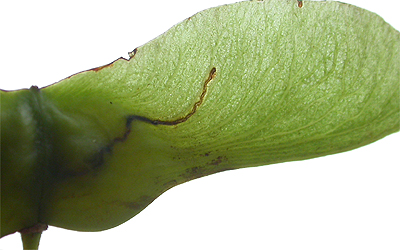 Ectoedemia louisella |
|
| Gallery
leafmines Most gallery forming leafminers are either Stigmella, Ectoedemia or Bucculatrix species, most of which are indeterminable to identify to species level without dissection, when in the adult stage. Even those species which construct similar gallery mines within leaves and share the same foodplant, can usually be seperated by the method of frass dispersal. Even if frass dispersal is linear, the width of the frass in relation to the width of the gallery can sometimes clinch the identification. If present, larval colouration or head colour, is another good key to identification and neccessary in some of the Hawthorn feeding Stigmellas. Not all gallery mines are found on the leaves. Some species mine the young bark and others, such as the larva of Ectoedemia louisella, actually mines the samara of Field Maple before entering the developing seed. Of the few species which do this, Ectoedemia louisella is by far the commonest and quite easy to find. |
||
| ............... | |||
 Stigmella plagicolella |
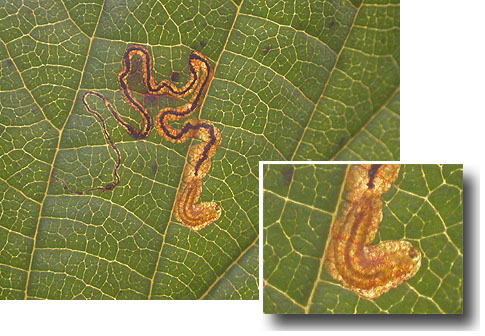
 Stigmella speciosa |
 Stigmella catharticella |
|
| ............... | |||
| Gallery mines
vary considerably, with some species constructing more
contorted galleries than others. The larvae of some
leafminers often construct a gallery mine initially,
which eventually becomes a blotch mine. A classic example
of this type of mine is that of Stigmella plagicolella,
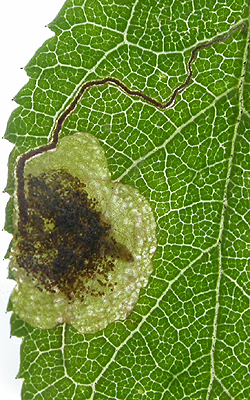
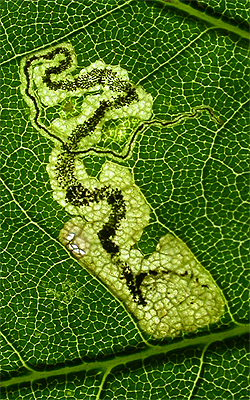
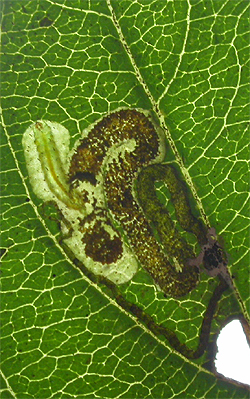
which is a very common mine found on Blackthorn. Although being found on Sycamore is a good indicator of species in this instance (few species mine Sycamore) the frass produced by the larva of Stigmella speciosa, initially starts as a thin line with clear margins, then becomes broader, but still with obvious margins. The gallery mine on Buckthorn produced by Stigmella catharticella, is completely filled with frass and there are no clear margins along the mine. |
|||
| ............... | |||
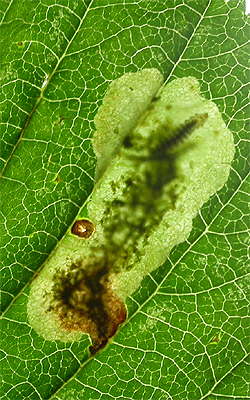
| Blotch
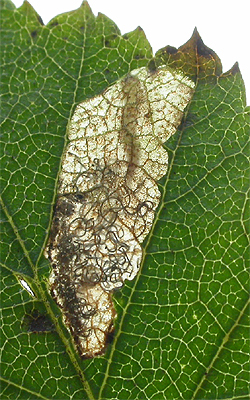
leafmines These mines again show considerable variation in size and shape and can be on either the upper or lower surface of the leaf. Frass within blotch mines is often dispersed unevenly, but some of of the Eriocranias produce distinctive "arcs" of frass, which helps towards the identification. Frass patterns or distribution in old mines, often cannot be used as an aid to correct identification, as the frass dries up and falls to the lower part of the leafmine. |
|||
| ............... | |||
Eriocrania salopiella |
 Parornix betulae |
 Cameraria ohridella |
|
| ............... | |||
| The blotch forming leafminers feature one particularly notorious and very well known species. Cameraria ohridella (the Horse Chestnut Leafminer) has become a familiar sight since arriving in Nottinghamshire nearly ten years ago, with literally tens of thousands of leafmines, covering virtually every Horse Chestnut tree within the county by late Summer. | |||
| ............... | |||
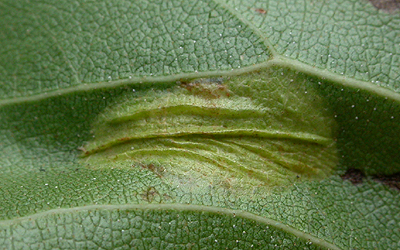 Phyllonorycter rajella |
C.
ohridella produces one of the most obvious upper
surface blotch mines, but the leafmines produced by other
species, are often more discreet and although they are
visible on the upper leaf surface, are actually lower
surface leafmines. Some of the most frequently recorded leafmines are those produced by the larvae of the Eriocranias and Phyllonorycters. Eriocrania mines are easy to distinguish and are among the first leafmines to appear in the Spring. Although most Eriocranias are Birch feeders, a combination of frass dispersal pattern, larval colour and even the number of larvae sharing the same mine, means that this is a relatively easy group of blotch miners to start with. |
||
| ............... | |||
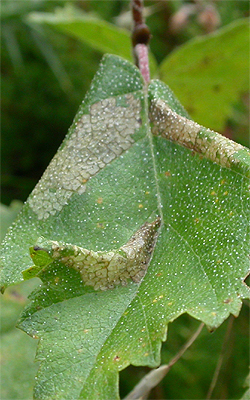
| Many Phyllonorycter leafmines are similar in appearance to those of Parornix betulae in the above photograph. The mine often causes the leaf to buckle and/or fold and the upper surface of the mine has a distinct mosaic appearance about it. Particular attention should be given to the leafmine length and in some cases, the number of creases present as the mine is enlarged. These creases are shown in the above photograph of the leafmine of Phyllonorycter rajella. Using the keys provided on the British Leafminers website, will ensure that most Phyllonorycter mines are identifiable from good photographs. | |||
| ............... | |||
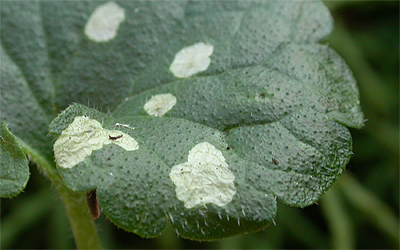 Coleophora albitarsella |
Coleophora
blotch mines Blotch mines produced by larvae of the Coleophoridae are more unusual in that the larva feeds inside the leaf, but constructs a protective case from a section of leaf in which it lives and feeds from. Experience gained through working with leafminers, will eventually mean that Coleophora blotch mines are distinctive enough to distinguish from other blotch mines at once. Coleophora larvae produce several blotches per leaf, usually visible from above and examination of the underside of the leaf, will show that each blotch has a circular hole, through which the larva has entered the mine and fed. There is no frass within the blotch mines made by Coleophora larvae, as this is expelled via the end of the larval case. |
||
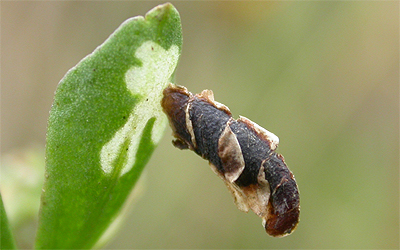 Coleophora discordella |
The sheer
variety of cases produced by Coleophora larvae,
means that most are distinctive enough to enable an
accurate species ID in the field. Identification of the
adult moths is virtually impossible and is only
accurately achieved by examination of the genitalia
through a microscope. Searching for leafmines Searching for leafmines will always be productive. Familiarity with larval foodplant is essential and a bit of background research prior to going out certainly helps and often pays dividends. The first leafmines can be found in the depths of Winter, when the white upper surface gallery mines of Stigmella aurella, are easy to find on Bramble. Searching for Stigmella aurella, will usually reveal the elongated blotch mines of Emmetia marginea, another common Bramble feeding species. |
||
| ............... | |||
| By late April, several of the Eriocrania leafmines will begin appear on Birch and Stigmella lapponica is another early species to look out for. As the Summer progresses, the potential number of species to be found increases dramatically and by the Autumn, as moth numbers at light traps begin to decline, there is still much of interest that can be looked for. | |||
| ............... | ||
| The leafmines of many
species don't start to appear till late in the year and a
number of them will not be found much before late October
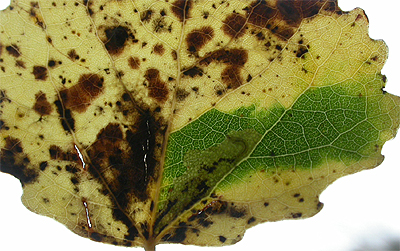
or November. While ever there are leaves on trees, it will always be possible to look for leafmines. But even when the last of the leaves have fallen, there is still a number of mines that can be looked for. Looking on the fallen leaves of Oak for characteristic 'green islands' will often reveal the presence of species such as Ectoedemia subbimaculella and Ectoedemia heringi, two common leafminers. The 'green island' caused by the larva of Ectoedemia argyropeza, is shown in the accompanying photograph. These are surprisingly easy to find when the moth is present at a site on fallen Aspen leaves. A good number of micromoths actively mine the needles of various Pines. Scots Pine is probably the most productive of all and even trees in urban areas, parks or gardens, will probably hold at least one species. |
Ectoedemia argyropeza |
|