
| The remarkable rise of the Small Eggar in Nottinghamshire in 2025 |
| ...... |
| In any year, there's usually
always one lepidopterous event making that year something quite
memorable, especially
for those with an eye always directed towards the record books. It
might be a national influx of a particular species, a surprising first county record
few expected,
or just a species having an exceptional year. In this instance, it was
the latter. At this point, I was going to suggest that this particular said instance, created something of a buzz within the moth trapping fraternity. But I tend to get the impression that people are now so often out of touch (or have no interest in) the past or present status of most species, or a particular record's importance as a record, or an event. Does anything unlikely turning up today, create even the remotest sense of excitement anymore, and have people lost that excitement or interest, which there once was? I'm not sure whether it's just the modern way of things. Where are those well-thumbed reference books we've constanly referred to since childhood? Are they forever sat on bookshelves gathering dust, or do we even still have them? |
 |
|
| ... | ||
| Our thirst for knowledge
now seems to be adequately satisfied, simply by reading through our social media news
feed, and that an identification is all we need to know anyway today. How we
get that identification doesn't matter, as we now have phone apps for
that kind of thing which save us time, so why do we need to learn what
makes that Rustic a Rustic, and not an Uncertain anymore? Even if a species is as rare as something can be, it seems hardly likely to generate any real interest anymore. While distinct advantages to this era of social media and its instant information still, just about outweigh the worst of social media and those using it to constantly demoralise and depress us, I can't help but think that something has happened in the last 20 years, where many now have little inclination to know more about much at all, even when it does flutter into their news feed. What's worse (for everybody really) is that people's thirst for knowledge, to know of, or to know about something, seems to be rapidly diminishing and I personally find that sad. I think we're losing the sense of excitement we once had, when we'd read about a record of some rare species turning up in the old (1970's and 1980's) Amateur Entomologist Society's bulletin, and wishing we could go out and catch one for ourselves, even knowing that the event was already many months out of date. I still remember reading an account of a Queen of Spain Fritillary being found and the obvious excitement of the observer was palpable in their write up of the event. Today's technology, allows us the chance to do now, what we couldn't back then. We have instant news regarding rare species, influxes, or events at our fingertips and we don't realise how lucky we are. Maybe it's an age thing, that if you're not old enough to remember how slow the spread of information was like, you can't appreciate the instant information we have today. |
||
| .... | ||
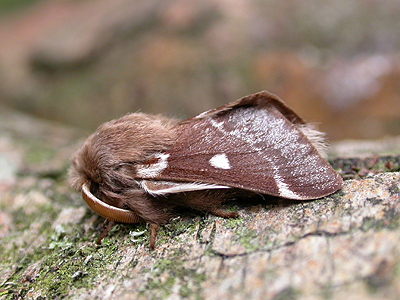 |
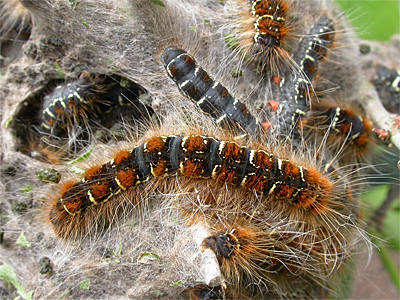
A changing menu But thankfully, there are still some people who do react to social media posts, are encouraged to go out and find for themselves a species someone's just posted a photograph of, often realising in the process, just how surprisingly easy it can be to quickly produce second or third county records. And it's fun, rewarding and importantly provides useful scientific records and data. But are the majority really that interested? While the lepidopterous menu is forever changing, with many new species arriving into the UK, colonising, or even recolonising in some instances, I sense an increasing lack of interest towards many social media posts regarding rare moths in Nottinghamshire and new county species etc. To my mind (and I know to that of a small number of others too) it is surprising that these posts don't seem to generate more interest, other than a handful of customary 'likes'. Nottinghamshire and some other UK counties, had one such event over the course of Spring 2025, with the sudden appearance (or reappearance?) of the Small Eggar Eriogaster lanestris, across much of north-eastern and eastern parts of the county. |
|
| .... | ||
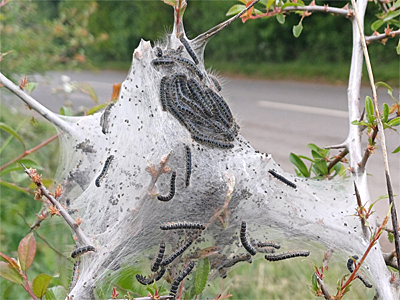
| The event was completely unexpected, especially in view of the moth's rare status and indeed, may well have passed completely unnoticed, had it not been for a post to the Nottinghamshire Moths and Butterflies Facebook page by Sharon Wilson. Sharon asked for an identification of some larvae on a dense, larval web she'd found at Kersall. I saw the post, identified the larvae and immediately mentioned how important the record was, especially in view of where this particular larval web was located. It was in a completely unknown area, or was it? | ||
| .... | ||
 |
Sharon's Facebook post, marked the start of me driving the country
lanes in the Kersall area, then outwards from there in all directions,
as was practically possible. Over the following weeks, large areas of
the county were covered - from
Retford to Newark, from Mansfield to Southwell and down to Nottingham, ultimately surveying
many miles of suitable-looking country lanes, checking the hedgerows for
larval webs along the way. Over the next few weeks, a surprising picture
of the Small Eggar's Nottinghamshire distribution emerged and the
distribution map changed on a daily basis. I tried to generate wider
interest using Facebook, uploading regular updates, photographs and
distribution maps, but I felt that my efforts largely failed to inspire,
although several others did join the search and contributed valuable
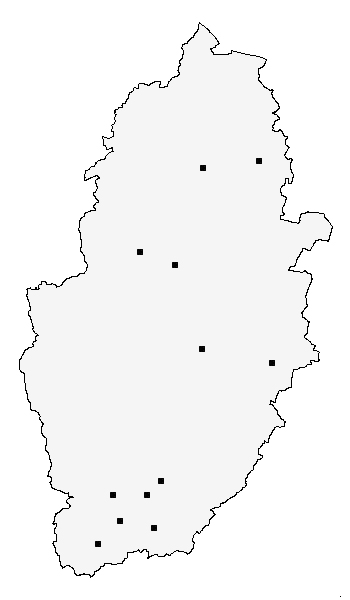
records to help map the event. And an event this very much was. It was completely out of the blue, involving a moth which had apparently been decreasing nationally for years, had never been common or remotely widespread in Nottinghamshire for over a century, and only known from one country lane IN the Trent Valley after a long absence. But in May 2025, it suddenly became a relatively easy find along many stretches of hedgerow containing Hawthorn Crataegus monogyna or Blackthorn Prunus spinosa. A Nottinghamshire history While on the face of it, it might seem as though the map on the left suggests that the Small Eggar was once a common moth historically, it wasn't and never has it been. After being well recorded by a number of entomologists in the late 1800's, records since then (up to the post-2000 era) have been as rare as the moth itself. The Small Eggar was more widespread in Nottinghamshire, but only really for a period of time and over a century ago. J.W. Carr in his book 'The Invertebrate Fauna of Nottinghamshire. Nottingham: J.& H. Bell Ltd (1916)', described the moth as being "widely distributed and often abundant in the larval stage". Carr went on to list many records of the moth, including Sherwood Forest (Brameld), Wellow (Becher), South Leverton, mentioning that "nests of larvae were very abundant some years" with two moths emerging from cocoons on March 20th 1897 (Thornley). Carr also listed records from Newark, March 18th-20th 1860 (Gascoyne) and that "nests of larvae were often abundant on Hawthorn Crataegus monogyna and Blackthorn Prunus spinosa about Southwell, Ruddington, Cotgrave, Bunny, Widmerpool, Normanton-on-the-Wolds and other places south of Nottingham". Mr D.H.Pearson bred specimens from Cotgrave larvae on March 13th and 16th 1892, February 16th and March 6th 1893 and February 28th 1894, noting that some specimens were three years in the pupa before emergence. |
|
| .... | ||
| Nottinghamshire records of the moth from the 1900's are almost
completely lacking and it would appear that, apart from an East Leake
record from 1980, the moth was as good as completely absent from the
county after those records listed by Carr. But it's not beyond the realm
of impossibility, that some other records may have slipped by unnoticed,
or were simply just kept secret by those in the know. Many of the Nottinghamshire Small Eggar records listed today on the NBN Atlas are those from Carr's book and two (so far) from the records of Dilys's and my own. What other records there are, aren't of any real use from a researcher's point of view, as important key points like date, location etc, which would make the records useable, are either witheld or just plain vague. Most of these come from East Leake, and there is an undated record from Retford, not listed by Carr. These are showed on the historical distribution map (above left), along with those listed by Carr. |
||
| .... | ||
| The
Small Eggar has been a species which I've surveyed and looked for over a
number of years, making an annual pilgrimage to walk Ingrams Lane from
Sutton-on-Trent to Grassthorpe, looking for the moth's conspicuous larval webs and
making a number of videos showing the larvae (or not) depending on my
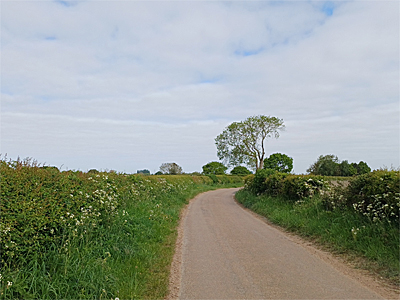
success each visit. For pretty much as long as anyone alive can remember, the innocuous looking Ingram's Lane (right) was just about the only home to one of Nottinghamshire's rarest breeding moths. Small Eggar was recorded from a couple of sites on the other side of the River Trent from Ingrams Lane, at both Besthorpe and Collingham in the early 2000's, but it's been Ingram's Lane (and on one occasion) Holme Lane at Sutton-on-Trent between 2002 and 2004 that produced the county's first records in over 60 years ..... but then nothing. The moth effectively went missing again in Nottinghamshire for another 15 years, before larval webs were again found at Sutton-on-Trent in 2020, 2021 and 2023. However, no larval webs were found here in both 2024 and 2025, despite being thoroughly surveyed for and it was feared that the moth had perhaps suffered through the recent severities in the weather over that time, though apparently not! |
 |
|
| .... | ||
| The Small Eggar has always been an extremely rare moth in
Nottinghamshire and it's a species which has also declined nationally
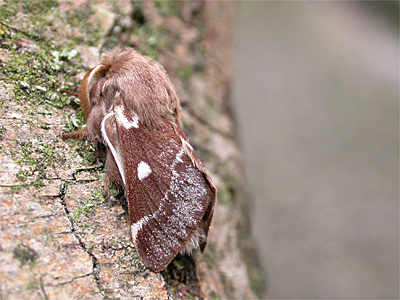
over recent years. It flies early in the year and its flight period is largely over with,
before most moth trappers have given any thought to dusting off their MV lights
before the start of another season's trapping. This may well be one
reason why there have been so few records, as the moth is seemingly rarely ever trapped, or
even attracted to light. But from what I found and learned about the Small Eggar in 2025, I'm now of the opinion that if every moth trapper in the county ran their traps from February to April, there'd still be no records. Unless they trapped alongside hedgerows containing stands of Blackthorn, Hawthorn (or both) in more rural locations, field margins etc, I doubt we'd ever record one. The moth appears to be more particular of habitat than we thought. |
| .... |
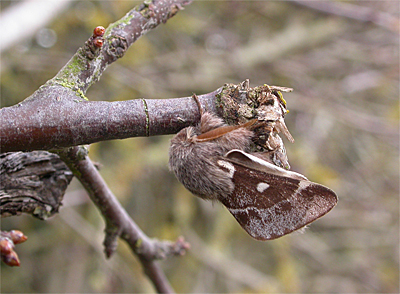 |
One did turn up to MV light in
Colin Watkins's Rampton garden in 2024, which was historically unusual
in terms of being attracted to light and in a garden setting, yet when
that record is taken into account now, it takes on a more important,
perhaps indicative role of what came a year later. It's likely (to me at least) that the indicators of a Small Eggar range expansion, resurgence, or reappearance (time will tell) were there a year previous and that through a general lack of awareness, many other 2024 records were probably missed, which was'nt the fault of anyone, as no one expected what was to come? But thankfully, not all records from 2024 passed unnoticed, as at least one larval web was found by Sharon Wilson at Kirton Brickworks in June 2024, which in itself, was a new site for the moth in Nottinghamshire, although it went unreported at the time, because the observer was unaware of the species and its Nottinghamshire status. Sharon then found the larvae at Kersall in May 2025, made the Facebook post and again, we had another new site away from the previously known Trent Valley locations. |
|
| .... | ||
|
Targetted surveying over
several weeks, went on to produce records of almost 50 larval webs that I
know of, most on roadside hedgerows during the course of May 2025.
But despite all these records coming away from it's traditional Sutton-on-Trent
site, it was surprisingly not found there in 2025, or found the year
before in 2024. The question then arose as to whether the moth had recently spread into these areas of Nottinghamshire, or had it
just remained completely undetected across
farmland areas for many years? It's likely the latter. Eggar or Ermine? The Small Eggar is unusual in that the pupal stage can apparently last seven years and the moth is known to have periods of abundance, or relative abundance for a number of years, before disappearing once again. This coming and going, could go some way towards explaining the moth's disappearance in Nottinghamshire in the past, but the periods where the moth hasn't been recorded, are considerably longer than the longest recorded period of pupation, which can be several years. |
||
| .... | ||
|
I think it's considerably likely that several Small Eggar eruptions have occurred on
a number of occasions over the past century or longer, it's just that
the moth tends to occur in those less populated, more rural parts of the county,
where moth trappers are rarer than a Small Eggar! But what helps us in the case of the Small Eggar, is that it's certainly much easier to find/record when in the larval stage, than it is as an adult. I wonder how many walkers have walked by larval webs in the past, let alone how many webs we've all driven past over the years? Small Eggar larval webs are conspicuous things, especially in their latter stages when they hang heavily from the branches of Blackthorn and Hawthorn, like discarded rubbish thrown from a moving car. If you don't expect to see them, you're hardly likely to go looking for them as you drive along, especially when many of the county's moth trappers do have an idea of the moth's Nottinghamshire range. If you're nowhere near Sutton-on-Trent, then you're hardly going to expect them elsewhere. |
 |
|
| .... | ||
|
During May 2025, some public interest in
Small Eggar larval webs did come as a direct link to another group of
moths, who's larval spinnings really take larval webs to another level.
Social media was flooded with photographs of whole sections of hedgerows and even trees covered with huge webs. Naturally, there was much nonsense directly associated with these photographs - claims of spider invasions, alien invasions, that the trees would die, or the planet would die etc. It was all par for today's over-imaginative course really, and absolutely untrue. |
||
| .... | ||
|
The fact that it was a small caterpillar causing these enormous webs, or
rather, thousands of small caterpillars, often did little to end the
wild social media speculation. But driving around any part of
Nottinghamshire at this time, you couldn't help but notice that Spindle
Ermine Yponomeuta cagnagella and Bird-cherry Ermine
Yponomeuta evonymella, were also having bumper years. Orchard
Ermine Yponomeuta padella numbers were also massively up on
those of previous years. I was able to map these moths too, on my
travels around the Nottinghamshire countryside and a number
of people also pointed me in the direction of other locations. As a consequence, our knowledge of these three moths in the county was also increased, and there was some evidence that other people were taking more of an interest at last. The two (right and above right) photographs provide a comparison of both Ermine sp and Small Eggar larval webs. The upper right photograph actually shows a Spindle Ermine web, covering a section of hedgerow at Eaton near Retford. It was perhaps the most wonderful example of such a web and I've never seen so many cars visibly slowing down to have a look. |
 |
|
| .... | ||
| It was certainly well photographed and on a number of occasions, I was asked directly if it was something invasive? It isn't (or wasn't) of course and it saddens me that people often immediately assume that because something is successful, it's something to be feared and invasive. But while ever we have various organisations or the media etc, pushing their 'it's invasive, be afraid and kill it' narrative, I'm afraid that as entomologists, we'll be questioned about this kind of thing increasingly more often in the future. |
| .... | ||
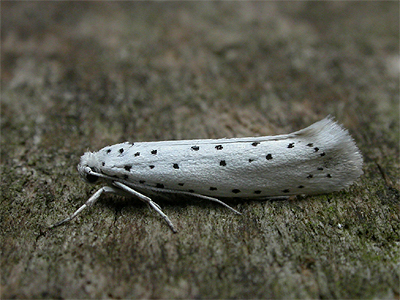 |
Naturally, some did get their identifications a little wrong and webs
reported to me as Small Eggar, were actually either Spindle Ermine (see
left)
despite there being considerable difference between the webs of the two
species. I posted photographs of most of the Small Eggar webs I found,
but misidentifications were still occasionally made. At the time, I
always tried to check most of those larval webs reported directly to me,
or posted on Facebook. That way, I ensured we ended up with an
accurate picture of the distribution of the Small Eggar in
Nottinghamshire during 2025. What was the key? Not only was 2025 the best year for most butterflies and moths for several years, but it marked my first year of early retirement, and so not only did I have much time on my hands, I found I had the eagerness of someone much younger than myself. It was a busy May and an exciting one too, being able to spend so much time in the field, purely driving around looking for larval webs and walking miles of hedgerow. |
|
| .... | ||
|
It was all worth it and there's already an
eagerness as to what will happen with the Small Eggar surveys in 2026.
There's the chance to add further sites to those from 2025, to test the
limits of its Nottinghamshire range and that of the likes of Spindle
Ermine (left) again too. With recent climatic changes, we're probably living in the most exciting times when rather selfishly looking at things from a lepidopterist's point of view. We've many new species moving north, some declining south and a number of potentially adventive species arriving here each year via the importation of plants and materials etc from around the world. And now a moth which has been with us for ever, is suddenly providing us with a rare opportunity to learn more about its range. It has always amazed me as to how a species can go from abundant to nowhere to be seen, within a short time frame. |
| .... |
|
I suppose many people don't
particularly care, they're happy to catch one, or just see one, but I
like to question more than just accept. But what has been the key to the
Small Eggar going from being such a rare moth with a handful of known
locations, to suddenly being pretty much everywhere it was looked for,
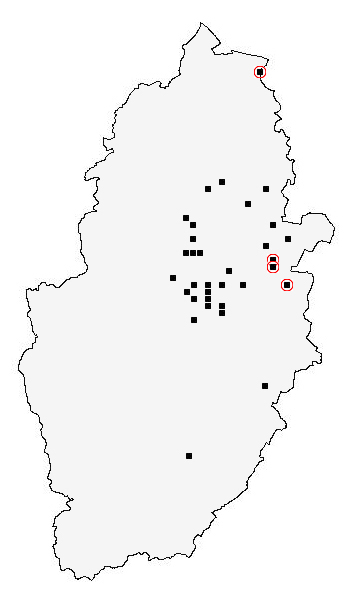
all within the space of a year or two, and will we ever know? I say a year or two, because on the morning following Sharon Wilson's Facebook post, I was in the area of her discovery and had already found two roadside larval webs within minutes of getting out of the car. My intention was to start in the general area of Sharon's find (Kersall) and systemtically work outwards in all directions. This resulted in me finding more larval webs in one day, than I'd seen at Sutton-on-Trent in several years. And as I widened my search, the more larval webs were found. It was the start of an exciting few weeks. Especially exciting personally, was finding Small Eggar on my local patch at Eakring, just south of Kersall, then at Eakring Meadows and then near Kneesall. After recording the moths of this area for some 20 odd years, I was suddenly finding a species I'd never dreamt of finding, although I had looked for it there for many years. Two webs were also recorded from nearby Wellow, so I was somewhat surprised that in all the years I'd run an MV light at Lound Wood near Eakring, Small Eggar had never turned up. The distribution map showed right is quite remarkable, considering that the county's post-2000 Small Eggar records are those showed ringed in red. The top record is of a single recorded by Neil Wood at Misterton Soss in 2019, right on the county border with Lincolnshire. Interestingly, this record preceded the first records in some 15 years from Sutton-on-Trent between 2020 and 2023, but it has proved to be an isolated record. It may be that the Misterton Soss individual was part of something more broadscale, rather than just an isolated wanderer. It may well have been an indicator, similar to Colin Watkins's Rampton record of 2024. When I met Sharon Wilson on the morning following her Facebook post, she mentioned that she had seen the same larvae and larval web at Kirton Brickworks back in 2024, so it looks to me that the 2025 Small Eggar eruption, resurgence, or range expansion, had begun at least a year earlier and that we'd largely missed it. That's a pity really, because there's no survey records to show whether the 2025 larval web counts, were up or down on those of 2024. There's no comparison, not until 2026 anyway. We'll never know for sure of course, but I feel there's little doubt that the moth was already considerably more widespread in 2024 and probably had been for several years prior to that. |
 |
|
| .... | ||
| The records for the Nottinghamshire distribution map of the Small Eggar, have been provided by the following contributors - Sheila Wright (Nottinghamshire macro moth report 2003). Sheila Wright (Nottinghamshire macro moth report 2004). Trevor and Dilys Pendleton. Sheila Wright (Nottinghamshire macro moth report 2007). Martin Kennewell. Recorder unknown (record per Martin Kenewell). Sharon Wilson. Sheila Wright (Nottinghamshire macro moth report 2019). Sheila Wright (Nottinghamshire macro moth report 2020). Nick and Samantha Brownley. Andrew Lidgett. Claire Wickham (via Nottinghamshire Moths and Butterflies Facebook Group). Melanie Penson (via Nottinghamshire Moths and Butterflies Facebook Group). Colin Watkin. Sheila Wright (Nottinghamshire macro moth report 2024). | ||
| .... | ||
|
I don't think that we can put the 2025 increase in Small Eggar
numbers down to range expansion, unless it's been going on for a number
of years. It's not possible that moths from Sutton-on-Trent emerged,
bred and then flew in all directions, laying in suitable habitat as they
went. I'm pretty sure that the moth has been within the recorded 2025
range for years and that it also remains in the south of the county.
There's some potentially useful survey work for those living south of
the River Trent. There's much suitable habitat down there, which wasn't
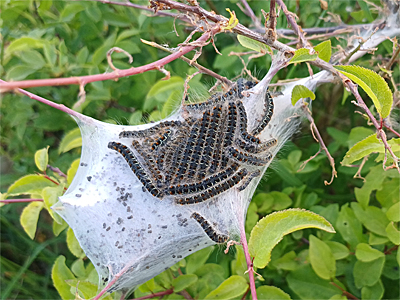
walked in 2025. The site furthest west on the 2025 distrbution map (abve right) where larval webs were found was Wellow, which is around 10 miles west from Sutton-on-Trent as the Small Eggar flies. Wellow is one of those historical sites which Carr listed in his 1916 publication and is the only historical site also listed in the table below, from over a century later. It's likely that the Small Eggar and other species which show huge fluctuations in numbers over a period of many years, for whatever reason, can simply exist for the most part, in very low numbers until conditions are, or have been, suitable. Parasitisation is obviously a potential factor infuencing Small Eggar numbers over time, but parasitisation in Small Eggar is thought to be quite low. |
 |
| Site/location | Web count | Hostplant | Habitat | Date | Recorder(s) | |||||
| Kneesall | 1 | Blackthorn | Field hedgerow | 03/05/25 | SW | |||||
| Kneesall | 3 | Blackthorn | Roadside hedgerow, with sucker regrowth | 05/05/25 | TP | |||||
| Norwell/Norwell Woodhouse | 1 | Blackthorn | Roadside hedgerow, with sucker regrowth | 05/05/25 | TP | |||||
| Norwell/Norwell Woodhouse | 1 | Blackthorn | Roadside hedgerow, with sucker regrowth | 05/05/25 | TP | |||||
| Kirton | 2 | Blackthorn | Roadside hedgerow (trimmed previous Winter) | 05/05/25 | NB & SB | |||||
| Carlton-on-Trent | 1 | Blackthorn | Roadside hedgerow, with sucker regrowth | 06/05/25 | TP | |||||
| Ossington | 1 | Blackthorn | Isolated Blackthorn scrub at roadside | 06/05/25 | TP | |||||
| Kneesall | 1 | Not Recorded | Field boundary hedgerow | 06/05/25 | AL | |||||
| Maplebeck | 2 | Blackthorn | Roadside hedgerow (not recently trimmed) | 08/05/25 | TP | |||||
| Eakring Meadows | 2 | Blackthorn | Roadside hedgerow (not recently trimmed) | 08/05/25 | TP | |||||
| Eakring Meadows | 1 | Blackthorn | Old Blackthorn stand | 08/05/25 | TP | |||||
| Tuxford | 2 | Hawthorn | Roadside hedgerow (trimmed previous Winter) | 08/05/25 | TP | |||||
| Caunton | 2 | Not recorded | Field boundary hedgerow | 06/05/25 | AL | |||||
| Milton | 2 | Blackthorn | Roadside hedgerow (trimmed previous Winter) | 09/05/25 | NB & SB | |||||
| Winkburn | 1 | Blackthorn | Roadside hedgerow (not recently trimmed) | 09/05/25 | TP | |||||
| Kirton Brickworks | 2 | Not recorded | Believed to be on isolated scrub | 10/05/25 | SW | |||||
| South Clifton | 1 | Blackthorn | Roadside hedgerow (not recently trimmed) | 13/05/25 | TP | |||||
| Grove | 1 | Blackthorn | Roadside hedgerow (not recently trimmed) | 15/05/25 | TP | |||||
| Bevercotes Pit Wood | 1 | Blackthorn | Trackside scrub | 15/05/25 | CW | |||||
| Fledborough | 1 | Hawthorn | On scrub growing on disused railway line | 16/05/25 | CWt | |||||
| Eaton Wood | 1 | Hawthorn | Roadside hedgerow (not recently trimmed) | 17/05/25 | NB & SB | |||||
| East Drayton | 2 | Hawthorn | Roadside hedgerow (recently trimmed) | 17/05/25 | NB & SB | |||||
| Hawton | 2 | Hawthorn | Roadside hedgerow (not recently trimmed) | 19/05/25 | TP | |||||
| Hawton | 1 | Blackthorn | Roadside hedgerow (not recently trimmed) | 19/05/25 | TP | |||||
| Kneesall | 1 | Blackthorn | Roadside hedgerow (not recently trimmed) | 19/05/25 | TP | |||||
| Caunton | 2 | Hawthorn | Roadside hedgerow (recently trimmed) | 19/05/25 | TP | |||||
| Kirton Brickworks | 1 | Hawthorn | Believed to be on isolated scrub | 20/05/25 | SW | |||||
| Wellow | 2 | Hawthorn | Roadside hedgerow (recently planted) | 23/05/25 | TP | |||||
| Moorhouse | 5 | Not recorded | Field hedgerow | 25/05/25 | SW | |||||
| Bingham | 1 | Blackthorn | On scrub growing on A46 embankment | 30/05/25 | MP | |||||
| ... | ||||||||||
| Nick and Samantha Brownley (NB & SB). Andrew Lidgett (AL), Trevor Pendleton (TP), Melanie Penson (MP), Sharon Wilson (SW), Colin Watkin (CWt), Claire Wickham (CW). Nottinghamshire Moths and Butterflies Facebook Group. | ||||||||||
| .... | ||
|
I did find parasitic larvae in one of
the two larval webs at Wellow and personally think that the rate of
parasitisation within larvae is higher than thought, especially
considering the high rates found in communal Nymphalid Small Tortoiseshell
Aglais urtica and Peacock Aglais io larvae. Small Eggar larval webs and locations in 2025 The 49 larval webs recorded in 2025 and known of at the time of writing, are listed in table form above. Larval webs were recorded by a number of observers between May 3rd and 30th 2025, but not after that date, although long-vacated webs were still visible for several months afterwards. The age range of the larvae found in the webs varied and by the middle of May, larval webs generally contained final instar larvae, although several roadside webs at Hawton, were already found to be vacated when found on May 19th. Webs were often located relatively close together and a thorough search, or a revisit to the area, would often lead to finding additional larval webs close by, which had previously been tucked away and not visible deep within growing foliage |
 |
|
| .... | ||
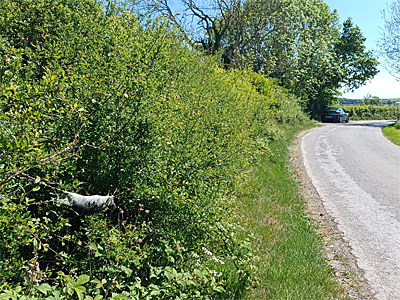
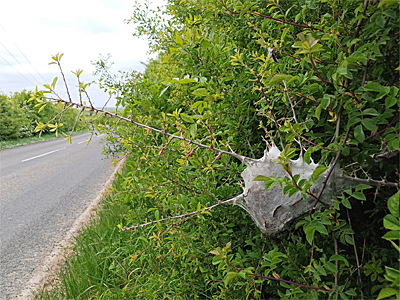
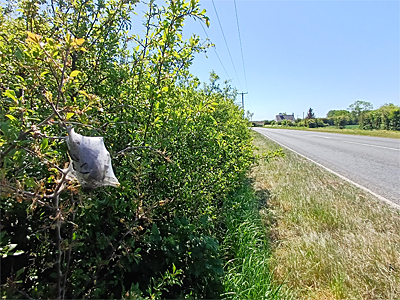
| Blackthorn (especially suckering regrowth) was generally preferred for egg-laying and although there was a clear preference for hedgerows cut every two or three years with a good amount of sucker regrowth, heavily cut hedgerows were still used. The ideal habitat is shown in the above right photograph, taken at Winkburn. It shows an uncut stretch of Blackthorn, which has suckered and grown out towards the road, with a larval web lower left. Larval webs could be alarmingly close to the road at times and numerous webs were found in this type of situation, including webs at Grove near Retford (below left) and at South Clifton (below right). | ||
| ... | ||
 |
 |
|
| .... | ||
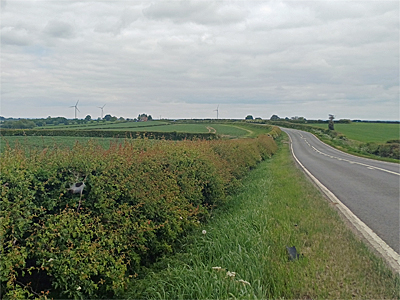
| It was certainly an experience, to drive around the Nottinghamshire countryside looking for such a rare moth on roadside hedgerows. How often do you get the chance to do that? But that's how I found many larval webs, simply seeing them as I drove by (they are that conspicuous) then parking up and walking back to confirm. That's how I found the larval web below left, which was one of two within close proximity along the busy A6075 near Tuxford. These webs were both on Hawthorn, which was used as the hostplant 33% of the time, based on those records where the hostplant was given. | ||
| .... | ||
 |
That habitat was also fairly typical in
which larval webs were recorded, generally in open, sometimes quite
exposed locations. But there were many suitable looking hedgerows which
didn't produce larval webs, despite much time and effort spent walking
them. As I mentioned earlier, the furthest west larval webs were recorded from, was just outside Wellow, with a northerly range seeming to just about stretch as far north as Retford and south to Southwell, but never close to Southwell, or south of it. A single web was located by Melanie Penson on the banks of the A46 at Bingham, which was an isolated record amongst those I had personally found, or had collated via social media posts, but I wouldn't have been at all surprised if more webs had been located along the length of the A46 south from Newark. There must have been so many larval webs which went undetected, webs well away from the roadside. Scanning with binoculars so as not to enter fields without permission was possible, but there's no doubt many were never found at the time. But nests were found to be detectable, even when the occupants had long since pupated. |
|
| .... | ||
|
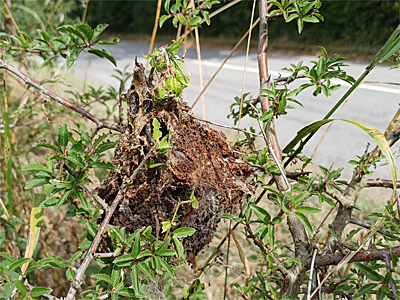
Looking somethin similar to a giant, used tea
bag, vacated webs could still be found intact and easily visible by late
August. In some cases, where the scrub had not been cut down, or the
hedgerow had not been trimmed by early Autumn, the remnants of a number
of webs, if you knew where they were, were still easily discernable as late as January 2026, as was the larval
web found at Ossington on January 2nd 2026. Below is one of the larval webs located at Kneesall on May 5th 2025 ( below left) and revisited again on August 14th (below right). Despite much rain during most of December 2025, the Ossington web was found to be completely dry inside and full of mould, when opened up on January 2nd 2026. |
||
| .... | ||
 |
 |
|
| .... | ||
|
The Small Eggar in 2026 I thoroughly enjoyed the May of 2025, especially being fortunate enough to be able to spend so much time looking for and finding larval webs of what has traditionally been a very rare moth in Nottinghamshire. Such opportunities don't present themselves to modern entomologists very often and it was great to see such a reversal in fortunes for the moth, after all this time. Maybe in those intervening years between the late 1800's and the 2020's, similar sudden increases have occurred and just been missed, as the moth (both historically and recently) has tended to occur in the less populated parts of the county. The only downside to this whole event, for me as a record/recording fanatic you could say, is that I think we likely missed the indication that something like this was to come in 2024, maybe even as early as 2023. I believe that had I done the same amount of searching for this species in 2024, rather than just my annual visit to check along Ingram's Lane at Sutton-on-Trent, then we would probably have found larval webs in some of the areas where they were recorded in 2025. Maybe if I'd paid more attention to those roadside stands of Blackthorn, more records wouold have come before 2025. |
||
| ... | ||
 |
As I have already mentioned, I failed to
find Small Eggar larvae along Ingram's Lane in both 2024, or 2025, but
thankfully Sharon Wilson did record larvae from Kirton Brickworks in
2024, but had no idea as to species or county status. So there was some
indication of what was to come. And now hopefully, others will have been
made more aware of the Small Eggar and will be alert for records in
future years? After such a surprising and somewhat amazing year in 2025, what is likely to happen in 2026? Will it be more of the same? I personally doubt it, but I do think that there will be larval webs to find, for those prepared to put in a little effort. Comparisons with Nottinghamshire's historical Small Eggar records (below left) with those of this post-2000 era (below right) doesn't really tell us a great deal, other than that virtually all the 2025 records came from sites where the moth had never been recorded from before .... at least as far as we know and purely on the basis of a lack of records from those sites. The maps are very different from each other though. The Small Eggar has clearly vanished from sites in the Sherwood Forest area and apparently from all sites in the south of the county. Does it remain in the East Leake area, even after such a long period of time? I think it does and that it's likely that it could reappear in other areas of south Nottinghamshire. |
|
| .... | ||
| A dividing line in more northern parts of Nottinghamshire, seems to be the A614. Try as both I and others might, we failed to record Small Eggar anywhere west of the A614, although based on the broad habitat of where we did record it from in north-east Nottinghamshire, the habitat just did'nt have the same 'look or feel' to it, in which to find Small Eggar. |
| .... |
|
|
|
|
| .... | ||
|
That might sound somewhat ridiculous to
claim, but when you become familiar with a species and its habitat
requirements, you get a feel for something and know it's just not right
for that particular species, or whether it's worth spending a great deal
of time looking for it. I find it's always better to look for a species
based from where it was last recorded and work outwards from there. But
there are many subtle differences to fields in all parts of the county
and a key difference may be in the underlying geology, rather than
initial appearance. For example, there were some ideal looking hedgerows
near Newton and Radcliffe-on-Trent, yet they produced nothing. The same
could be said for the wider area south and west of Southwell, where it
was extensively looked for but not found. Of course, that doesn't mean
it's not there. Soil composition could play a factor in the Nottinghamshire distribution of the Small Eggar. Based on the locations producing records in 2025, many lie on a clay-based soil, or at least soils which hold a certain amount of moisture across any year. The Trent Valley, while not producing much in the way of larval webs in 2025, could still prove to be a rewarding area of the county to survey for the moth, as would be anywhere north of Retford, where it was looked for but not found. As a final thought, is it any coincidence that the resurgence of the Small Eggar in 2025 came after several hot, dry years such as 2022 and 2023? Is it the overall geological and meteorological conditions combining to create the perfect conditions for successful breeding? There's so many potential questions to find the answer to, in order to help find the mystery of why a moth which had been increasingly rare for a century or more, suddenly made such a dramatic comeback. But it's a comeback which could so easily have been missed and will a similar event ever be recorded again? |
||
 |
| Moths |
| Insect identification |
| Homepage |