
| The Oil Beetle Meloe proscarabaeus in Nottinghamshire |
| Monitoring Nottinghamshire's Oil Beetles - latest survey results |
| ..... |
| This surprising recent re-addition to Nottinghamshire's invertebrate fauna (seemingly after an absence of around 50 years) was discovered at a site within the Sherwood Forest NNR by Adrian Dutton and his wife on April 2nd 2011. After thorough surveys of the site immediately after (and since) the discovery, we monitored the colony's increase for a number of years. | ||
| ..... | ||
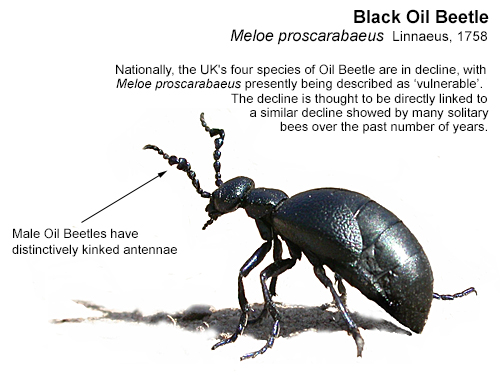
| Nationally, the UK's four
species of Oil Beetle are in decline, with Meloe
proscarabaeus presently described as vulnerable. The
decline is thought to be directly linked to a decline in many bee species. How long this beetle has been within the NNR is unknown, but it must must have been present for at least several years prior to its discovery and for some reason remained undetected. With the beetle's large size (up to 40mm for some females) it is hard to imagine how they had gone unnoticed before. Previous records of any Oil Beetle in Nottinghamshire, date back to the turn of the last century. Oil Beetles cannot fly and dispersal to new areas is only by the larvae hitching a ride on solitary bees, so the first larvae must have been carried in by bees from some distance away. However, with news of a second colony being reported by James Glendenning at Newstead Abbey in 2013, it seemed likely that there could possibly be other colonies elsewhere in the county - something confirmed in 2023, when Meloe proscarabaeus was found at Clumber Park. |
 |
|
| ..... | ||
|
Oil Beetles in Nottinghamshire - a round up of the county's
historical records In Nottinghamshire, there are a number of historical records/sites for Meloe proscarabaeus listed by J.W. Carr in his 1916 book 'The Invertebrate Fauna of Nottinghamshire'. Unfortunately, no records are dated and Carr's account reads ' Nottingham; Colwick Wood; Bulwell Forest, common; many Halictus and Andrena Bees captured on Bulwell Forest and at Gedling in Spring, had larvae of Meloe attached to them (Carr). Kimberley (Thornley) Clarborough Hill near Retford (Chamberlain)'. Carr also lists a single (undated) record of Meloe violaceus from Bulwell Forest, Nottingham (Ryles), which if anything adds confusion as to whether this was just a simple misidentification, or that there were indeed two species present at Bulwell Forest (long since a golf course). In 2019, we received an email mentioning that Oil Beetles identified at the time as M. proscarabaeus, were still present at Bulwell Forest GC in the early 1970's, from just off the public footpath crossing the site between Bestwood Road and Hucknall Road at SK547460 (per Scudder, L.). The latest reports show that there are now three known locations for this beetle in Nottinghamshire. These are located at Budby South Forest and Newstead Abbey, with a third recently found in Clumber Park. |
||
| ..... | ||
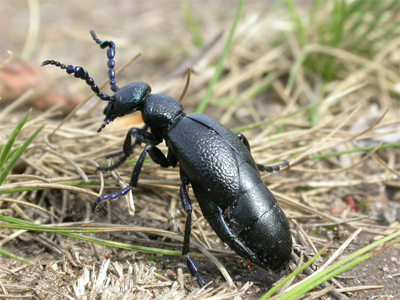 |
An unusual life
history Oil Beetles have interesting life histories. The larvae are parasites of ground nesting solitary bees, near to which the female excavates a burrow. The female lays up to 1000 eggs that hatch to coincide with numbers of ground nesting solitary bees. What was also especially significant, was the presence of large numbers of Andrena cineraria, possibly the host species for the Oil Beetle larvae (Triangulins). After hatching some eggs in captivity after about two weeks, it seems possible that female beetles emerge and lay eggs around two weeks before the peak numbers of this solitary bee, as there had been little evidence of solitary bee activity along this path in mid-April when the first females were found. |
| ..... |
| The Triangulins are extremely active, climbing flowers and waiting for the host bee to come along, but they will attach themselves to hoverflies, butterflies and the wrong type of bee. If they are successful, they attach themsleves to the host bee and are taken back to the bee's burrow, where the Triangulin changes into a grub-like larva which then feeds on the pollen stores and eggs of its host. Pupation occurs within the burrow, before the adult beetle emerges the following Spring. |
| ..... |
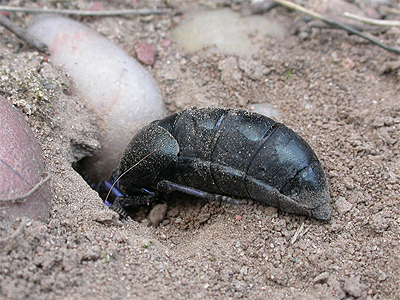
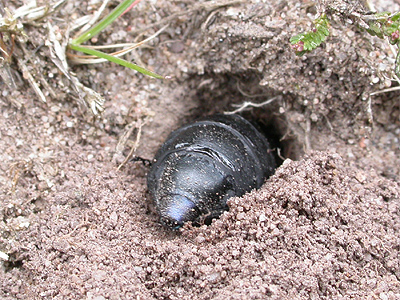
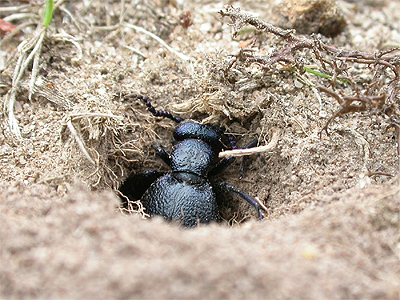
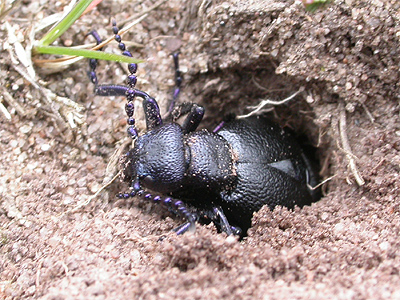
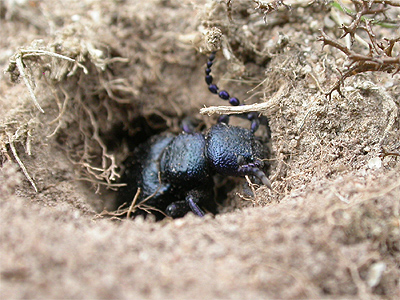
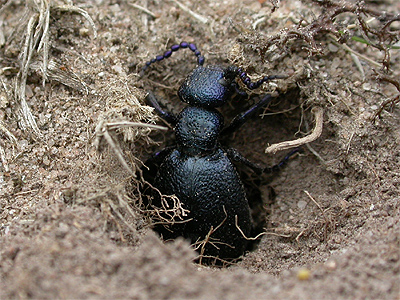
| Burrow
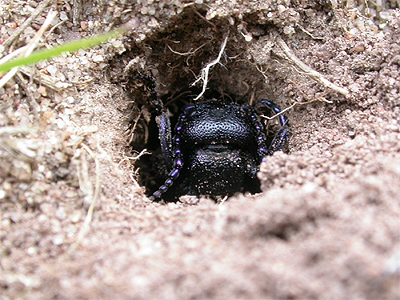
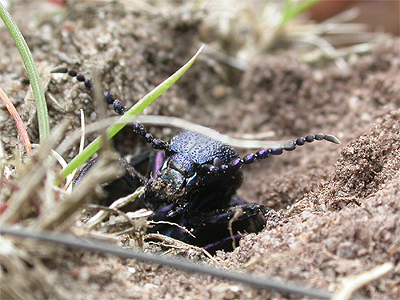
excavation and egg-laying This sequence of photographs shows the burrowing process observed in April 2011. Burrowing was often a lengthy process which most often occurred during the afternoon, with the excavating, egg laying and back-filling taking around two hours to complete. The burrow is excavated in a suitable location near to the nests of ground nesting soilitary bees. Burrowing seemed to commence from late morning onwards and by mid-afternoon, several females could be present along one small stretch of path, actively burrowing within feet of each other. |
||
| ..... | ||
 |
 |
|
| ..... | ||
| When the burrow is complete, females reverse back out and turn around before reversing back down the burrow again. The depth of the burrows we witnessed being excavated, was found to be about 1cm deeper than the length of each female. Particularly large females could go down as far as 6cm. | ||
| ..... | ||
 |
 |
|
| ..... | ||
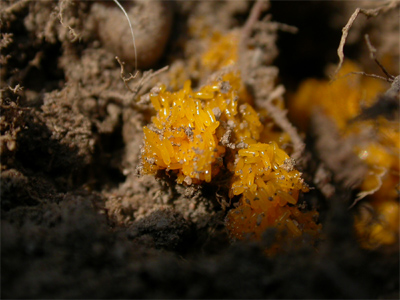
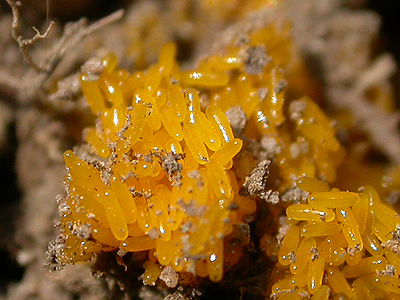
| The female lays around 1000 bright yellow eggs at the bottom of the excavated burrow. The eggs shown in the following two photographs were taken after two burrows were found opened, presumably by some other invertebrate or even another female Oil Beetle digging an easy burrow in what was pretty compacted sandy soil.. | ||
| ..... | ||
 |
 |
|
| ..... | ||
| Backfilling was quicker than the actual burrow excavation. The process involved the female turning around in the burrow and dragging the loose soil into the burrow with her front legs. | ||
| ..... | ||
 |
 |
|
| ..... | ||
 |
 |
|
| ..... | ||
| On finding
several burrows opened with the eggs exposed, we took
some back home with the aim of photographing the hatched
Triangulins a year later (the length of time given by
some internet resources). However, we were surprised to
find that they hatched just over two weeks after being
laid, being yellow on hatching but turning more orange
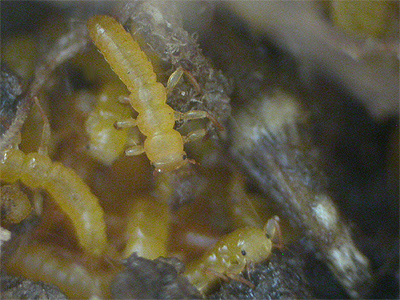
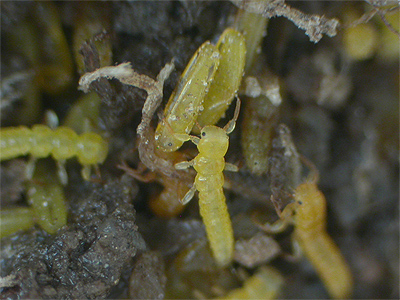
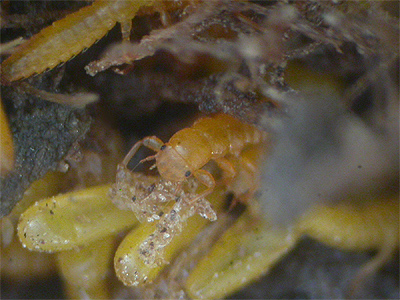
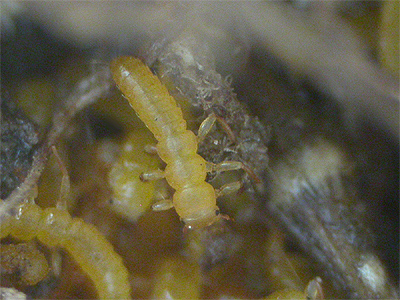
after a few hours. The following photographs were taken on May 2nd 2011 after which the 1.5mm long Triangulins were released back on site. At the time of release, it was obvious that there had been a large emergence of the bee Andrena cineraria (coinciding perfectly with the two week hatching of the Triangulins) with many males and several females present in the exact same area where several female Oil Beetles were still continuing to burrow and lay eggs. It seems very likely that A. cineraria is indeed the host species for this splendid beetle. |
||
| ..... | ||
 |
 |
|
| ..... | ||
 |
 |
|
